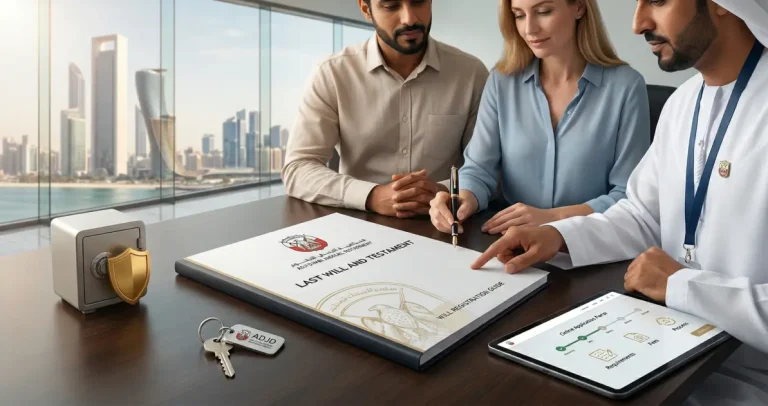

UAE Inheritance Law for Non-Muslim Expats: 2026 Guide
Yes: under UAE inheritance law for non-Muslim expats, you can opt out of Sharia succession and have your estate distributed according to the law of your home country, provided you put a valid will in place. This certainty arrived with Federal Decree-Law No. 41 of 2022 on Civil Personal Status for Non-Muslims, which took effect on 1 February 2023. Before this reform, succession at the federal level was traditionally governed by Federal Law No. 5 of 1985 (Civil Transactions Law), which applied Sharia principles by default. Today, registering a will is the cleanest way to control who inherits your UAE property, bank accounts, and shares in your company.
Key Takeaways
- Federal Decree-Law No. 41 of 2022 lets non-Muslim residents apply the law of their home country to inheritance instead of default Sharia rules.
- The Decree-Law took effect on 1 February 2023 and covers marriage, divorce, inheritance, and child custody.
- The Abu Dhabi Judicial Department (ADJD) opened a Non-Muslim Wills Registration Office in 2018 for residents who own assets in the UAE.
- An ADJD will can be registered online, including notarisation by video call, so a physical trip to Abu Dhabi is generally not required.
- Without a registered will, default succession rules can apply, and asset distribution may not follow your wishes.
How UAE inheritance law for non-Muslim expats actually works
For decades, expats worried that Sharia forced-heirship rules would override their wishes. That concern is now far easier to manage. Federal Decree-Law No. 41 of 2022 regulates the family affairs of non-Muslim residents and, importantly, lets them choose the law of their country of nationality, or an alternative personal status law, over the Decree-Law’s default provisions.
In practice, this means a non-Muslim resident can elect their home-country rules to decide who inherits and in what share. As a result, a parent can leave assets to a spouse or children in proportions that reflect their own intentions rather than a fixed formula. You can read the official summary on the UAE Government Portal for Civil Personal Status for Non-Muslims.
What changed from the old framework
Previously, inheritance at the federal level followed Federal Law No. 5 of 1985, which applied Sharia principles to succession. Although that framework still exists in the background, the 2022 reform created a clear opt-out path for non-Muslims. Therefore, the practical question for most founders is no longer “can I avoid the default rules?” but “have I documented my choice correctly?”
Why a will still matters under the new law
Notably, the right to apply your home-country law is most effective when it is written down and registered. A registered will tells the courts exactly how to treat your estate and reduces the risk of delay or dispute. Furthermore, a will lets you name guardians for minor children and appoint an executor, which the default rules do not address in the way most parents want. For tailored drafting, our UAE Will Drafting Services help expats translate their wishes into an enforceable document.
Registering an ADJD will: the route for Abu Dhabi and the Northern Emirates
The Abu Dhabi Judicial Department introduced its Non-Muslim Wills Registration Office in 2018 for non-Muslims who own assets in the UAE. Since then, the registration process has moved largely online, which makes it convenient for busy business owners. You can review the authority directly on the ADJD official website.
As of 2026, the ADJD process follows a clear sequence. First, you submit the application through the website. Next, an employee reviews it, and an SMS informs you of approval or any required modifications. After that, you pay the fees, then book an appointment to notarise the will by video call. Because of this digital flow, you can complete most of the steps remotely.
Step-by-step: how the ADJD process runs
- Submit your will application through the ADJD website.
- Wait for an ADJD employee to check the application.
- Receive an SMS confirming approval or requesting modifications.
- Pay the applicable registration fees.
- Book an appointment and notarise the will via video call.
For end-to-end support with this filing, our ADJD Will Registration service guides expats through each stage, from drafting to notarisation.
ADJD will vs DIFC Wills: a quick comparison
Expats often ask which registry to use. The answer depends on where your assets sit and how you weigh cost against coverage. The table below compares the two common routes at a high level. Confirm current fees with each authority before you proceed, because schedules change.
| Feature | ADJD Non-Muslim Will | DIFC Wills |
|---|---|---|
| Operating authority | Abu Dhabi Judicial Department | DIFC Courts (Dubai) |
| Typical asset focus | Abu Dhabi and Northern Emirates assets | Often used for Dubai and worldwide assets |
| Registration model | Online application with video-call notarisation | Online and in-person options |
| Language | Arabic and English supported | English-language registry |
| Best for | Residents wanting an ADJD-recognised will | Residents preferring a common-law forum |
While both options can work, the right choice depends on your residency, your property locations, and your business structure. Consequently, many founders combine a will with broader corporate structuring so that company shares pass smoothly to the intended beneficiaries. If you are still forming your entity, align your succession plan with company formation from the start.
What happens to your UAE assets without a registered will
If you die without a registered will, the courts apply default succession rules to your UAE estate, and the outcome may not match your wishes. For non-Muslims, the 2022 Decree-Law provides a pathway to home-country law, yet that pathway is far smoother when documented in advance. Therefore, leaving the question open can create delay, freeze accounts temporarily, and add stress for your family at a difficult time.
Practical risks for founders and SMB owners
- Bank accounts may be frozen until the estate is settled, which can disrupt business cash flow.
- Company shares may transfer in a way that complicates control or operations.
- Jointly owned property does not always pass automatically to a surviving spouse.
- Guardianship of minor children may follow a default route rather than your choice.
Because these risks touch both personal and corporate assets, a short legal consultation early can save significant time later. In addition, founders with cross-border interests should consider a legal due diligence review of how their holdings are titled.
Frequently Asked Questions
Can non-Muslim expats in the UAE avoid Sharia inheritance rules?
Yes, non-Muslim expats can apply the law of their home country instead of Sharia rules under Federal Decree-Law No. 41 of 2022. This Decree-Law took effect on 1 February 2023 and covers inheritance, marriage, divorce, and child custody. To make this choice clear and enforceable, register a will that documents your intended distribution.
What happens to my UAE assets if I die without a registered will?
Without a registered will, the courts apply default succession rules, and your assets may not be distributed as you intended. Accounts can be temporarily frozen, and jointly owned property may not pass automatically to a spouse. A registered will gives the courts clear instructions and reduces delay for your family.
How much does it cost to register a non-Muslim will with the ADJD?
The ADJD charges a registration fee that you pay online after your application is approved. Because fee schedules can change, confirm the current amount on the ADJD official website before you proceed. The process includes application review, fee payment, and notarisation by video call.
Is an ADJD-registered will valid in Dubai and the other emirates?
An ADJD-registered will is recognised within the UAE court system and is commonly used for Abu Dhabi and Northern Emirates assets. For Dubai-focused estates, some residents choose the DIFC Wills registry instead. The best route depends on where your assets sit, so review both options before deciding.
Do I need to visit Abu Dhabi in person to register an ADJD will?
No, you generally do not need to travel to Abu Dhabi, because the ADJD process runs online. You submit the application via the website, receive approval by SMS, pay the fees, then notarise the will through a video-call appointment. This digital flow makes registration convenient for busy founders.
Does a jointly owned UAE property automatically pass to my surviving spouse?
No, jointly owned UAE property does not always pass automatically to a surviving spouse. The outcome depends on the title, the applicable law, and whether a valid will is in place. A registered will is the clearest way to direct how your share of the property should pass.
Disclaimer: This article is for general informational purposes only and does not constitute legal, tax, or regulatory advice. Rules and fees in the UAE change frequently. Before acting on anything you read here, speak to a qualified advisor — we are happy to help.