
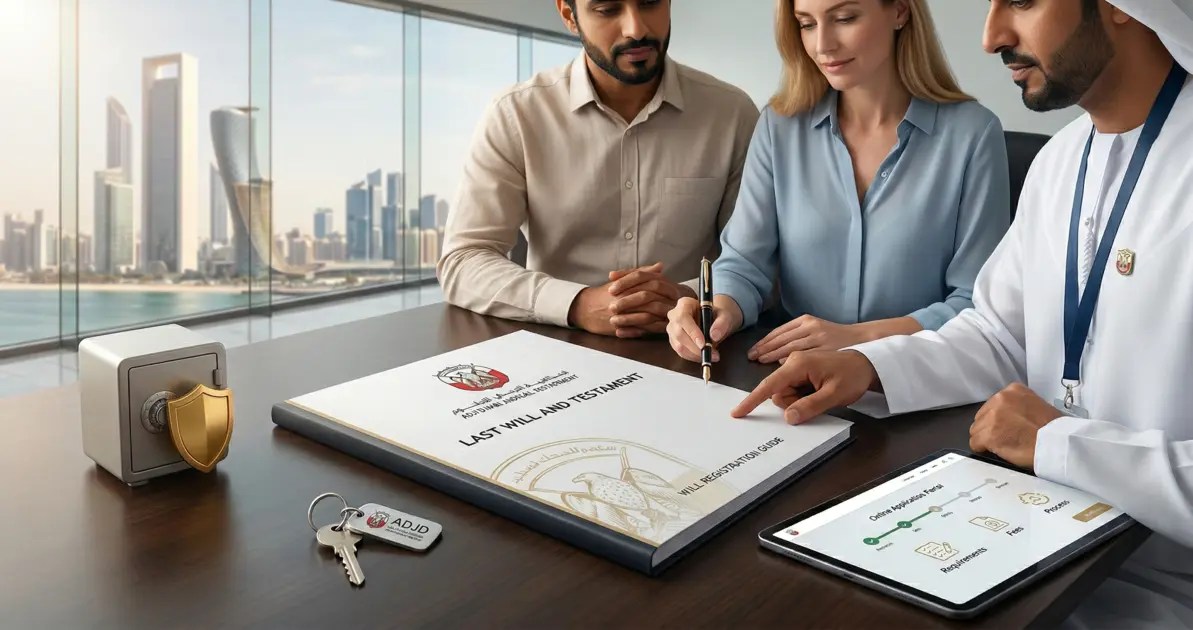
ADJD Will Registration: Online Process, Fees & Steps
ADJD will registration is the official process through which non-Muslim residents and investors in the UAE register a civil will with the Abu Dhabi Judicial Department, allowing them to determine how their local assets and guardianship of minor children are handled instead of having default Sharia inheritance principles applied. As of 2025, the entire process can be completed remotely through document uploads, portal-based payments, and a secure video call with an official notary.
Key Takeaways
- An ADJD civil will allows non-Muslims in the UAE to override default Sharia inheritance distribution and specify their own beneficiaries, executors, and guardians for minor children.
- The process is fully digital: document uploads, online fee payment, and identity verification via a secure video call with no in-person visit required in most cases.
- Government fees are fixed at AED 950 for a single will and AED 1,900 for a mirror will (married couples), with complex structures potentially reaching AED 3,000.
- An ADJD-registered will can be enforceable across all UAE emirates, covering assets such as bank accounts, property, vehicles, and business interests.
- No witnesses are required because identity and consent are verified digitally during the video notarisation appointment.
Why Non-Muslim Expats Need an ADJD Will in the UAE
Default Inheritance Rules Without a Will
When you hold assets in the UAE, whether bank accounts, real estate, vehicles, or business interests, those assets fall under local jurisdiction. If you pass away without a registered will, UAE courts may apply default Sharia inheritance principles to distribute your estate.
For many expat families, this default distribution does not align with their intentions. A surviving spouse, for example, may receive a share that differs significantly from what the couple planned. Similarly, guardianship of minor children can become uncertain without a clear legal document in place.
What an ADJD Civil Will Protects
An ADJD civil will gives you a formal, court-recognised mechanism to specify exactly how your UAE-based assets should be distributed. It also allows you to name guardians for your children, appoint executors, and set clear instructions that reduce ambiguity during an already difficult time.
A will is not only about distributing assets. It is about removing uncertainty for the people you care about when they are most vulnerable. If you are weighing your options, our will drafting service can help you understand the best approach for your circumstances.
Nationwide Jurisdiction Across the UAE
A common misconception is that an Abu Dhabi-registered will only covers assets located in Abu Dhabi. In practice, an ADJD will can apply across the entire UAE for many types of assets. Whether your property is in Dubai, your business operates in Sharjah, or your savings sit in an Abu Dhabi bank account, a single ADJD registration may provide enforceable coverage nationwide.
This cross-emirate reach is frequently cited as a major advantage over more jurisdiction-specific alternatives. For founders with assets spread across multiple emirates, it can simplify estate planning considerably.
ADJD Will Registration: Eligibility and Requirements
Who Is Eligible to Register?
Eligibility for ADJD will registration is designed to be broadly accessible. In general, you may qualify if you meet the following criteria:
- Age: You must be a legal adult. While guidance varies slightly on the exact minimum age, many practitioners recommend being over 21 for complete clarity.
- Residency: You do not necessarily need to live in the UAE to register. If you hold UAE-based assets, you may be eligible regardless of where you currently reside.
- Religious background: The ADJD civil will registry is primarily used by non-Muslims who wish to apply civil law principles to their inheritance rather than default Sharia rules.
Essential Document Checklist
Before starting the online application, prepare the following documents to avoid delays:
- A professionally drafted will: You can use the ADJD’s standardised dual-language template (Arabic and English) or prepare a custom will through professional legal consultation. Custom wills typically must be translated into Arabic by an approved translation centre.
- Official identification: A valid passport copy is required. UAE residents should also provide the front and back of their Emirates ID card.
- Proof of assets: If you list specific assets, you may need supporting documents such as bank statements, property title deeds, or company registration certificates.
- A signed copy: Upload a signed version of your will and ensure your signature matches the one on your passport.
No Witnesses Required
Unlike many other jurisdictions, the ADJD process does not require physical witnesses during registration. Instead, identity and consent are verified through the portal’s secure digital procedures, including the video notarisation call. This feature makes ADJD will registration online particularly convenient for busy professionals and expats living outside Abu Dhabi.
The Step-by-Step ADJD Will Registration Process
The ADJD will registration process is built around a digital-first workflow designed to minimise physical visits. If your documents are correctly prepared, the entire procedure can typically be completed within 7 to 10 days.
Step 1: Draft and Translate Your Will
First, your will should clearly name your executor(s), beneficiaries, and, if applicable, guardians for minor children. Because court processes in the UAE operate in Arabic, you will need a dual-language version. The Arabic translation must be completed by a certified legal translator.
For documents requiring official certification, our attestation service can assist with the process.
Step 2: Log In to the ADJD Portal and Upload Documents
Next, access the ADJD portal using your UAE Pass credentials. Locate the service for authenticating a civil will, then upload all required documents as PDFs or image files. The portal interface provides prompts throughout the upload process.
Step 3: Official Review and Fee Payment
After submission, ADJD staff review your application for completeness, translation accuracy, and identification validity. Once approved, you receive a notification to pay the applicable government fee and schedule your virtual verification appointment. Payment is made by card directly through the portal.
Step 4: Video Call Verification with a Notary
At your scheduled time, you join a secure video conference with an official ADJD notary. The notary verifies your identity by comparing your appearance with your passport photo and confirms that you understand and accept the will’s terms voluntarily. Importantly, no in-person visit is needed in most cases.
Step 5: Final Registration and Electronic Issuance
Finally, after successful verification, your will is officially registered and issued electronically through your portal account. The document includes an official stamp and payment receipt, forming a binding legal record you can download and share with trusted family members.
ADJD Will Fees: A Complete Cost Breakdown
Government fees for ADJD will registration are structured as fixed tiers, which makes budgeting straightforward. Below is a summary of the commonly cited costs as of the latest 2025 guidance.
| Will Type | Government Fee (AED) | Best For |
|---|---|---|
| Single Civil Will | AED 950 | Individual expats registering one will covering their UAE assets |
| Mirror Will (Couple) | AED 1,900 | Married couples registering two aligned wills simultaneously |
| Complex Will | Up to AED 3,000 | Individuals with extensive portfolios, multiple asset classes, or detailed distribution clauses |
Understanding Additional Costs
The government fees above cover court-side registration and video notarisation. However, you may incur separate costs for professional will drafting, legal consultation, and certified Arabic translation. These ancillary costs vary depending on the complexity of your estate, but they are generally considered reasonable relative to the legal protection gained.
Amendments and Future Updates
Life circumstances change, and the ADJD framework accounts for this. You can amend your registered will at any time by revising the document and re-registering it through the same portal process. This flexibility is particularly valuable for founders and business owners whose asset structures evolve over time.
For guidance on structuring business assets within your estate planning, consider reviewing options around corporate structuring.
Frequently Asked Questions
Is an ADJD will valid across all UAE emirates?
Yes, an ADJD-registered will can be enforceable across the entire UAE for many asset categories. This means a single Abu Dhabi registration may cover property in Dubai, business interests in Sharjah, and bank accounts held in any emirate. The cross-emirate applicability is one of the most frequently cited advantages of the ADJD framework compared to more localised alternatives such as DIFC wills.
Do I need witnesses for ADJD will registration?
No, witnesses are not required for ADJD will registration. The process relies on secure digital verification procedures, including portal-based identity checks and a video notarisation call with an official ADJD notary. As a result, this eliminates the logistical challenge of gathering witnesses that many other jurisdictions require.
Can I complete ADJD will registration entirely online?
Yes, the entire process can be completed remotely. You upload documents through the ADJD portal, pay fees by card online, and verify your identity through a secure video call. No in-person visit is needed in most cases, and the portal provides step-by-step guidance throughout.
How long does ADJD will registration take?
The process typically takes 7 to 10 days from submission to final electronic issuance, provided your documents are complete and correctly prepared. Timelines can vary depending on review cycles, translation accuracy, and the volume of applications being processed at the time.
Can I amend my ADJD will after registration?
Yes, you can update your ADJD will at any time by revising the document and re-registering through the portal. This is particularly important as your circumstances change, whether through acquiring new assets, changes in family status, or updates to your business holdings in the UAE.
What is the difference between a single will and a mirror will?
A single will covers one individual’s estate and costs AED 950 in government fees. In contrast, a mirror will is designed for married couples who want aligned wills with reciprocal terms, typically naming each other as primary beneficiaries. The mirror will costs AED 1,900 and registers both wills simultaneously, ensuring consistency between the two documents.
Disclaimer: This article is for general informational purposes only and does not constitute legal, tax, or regulatory advice. Rules and fees in the UAE change frequently. Before acting on anything you read here, speak to a qualified advisor — we are happy to help.