
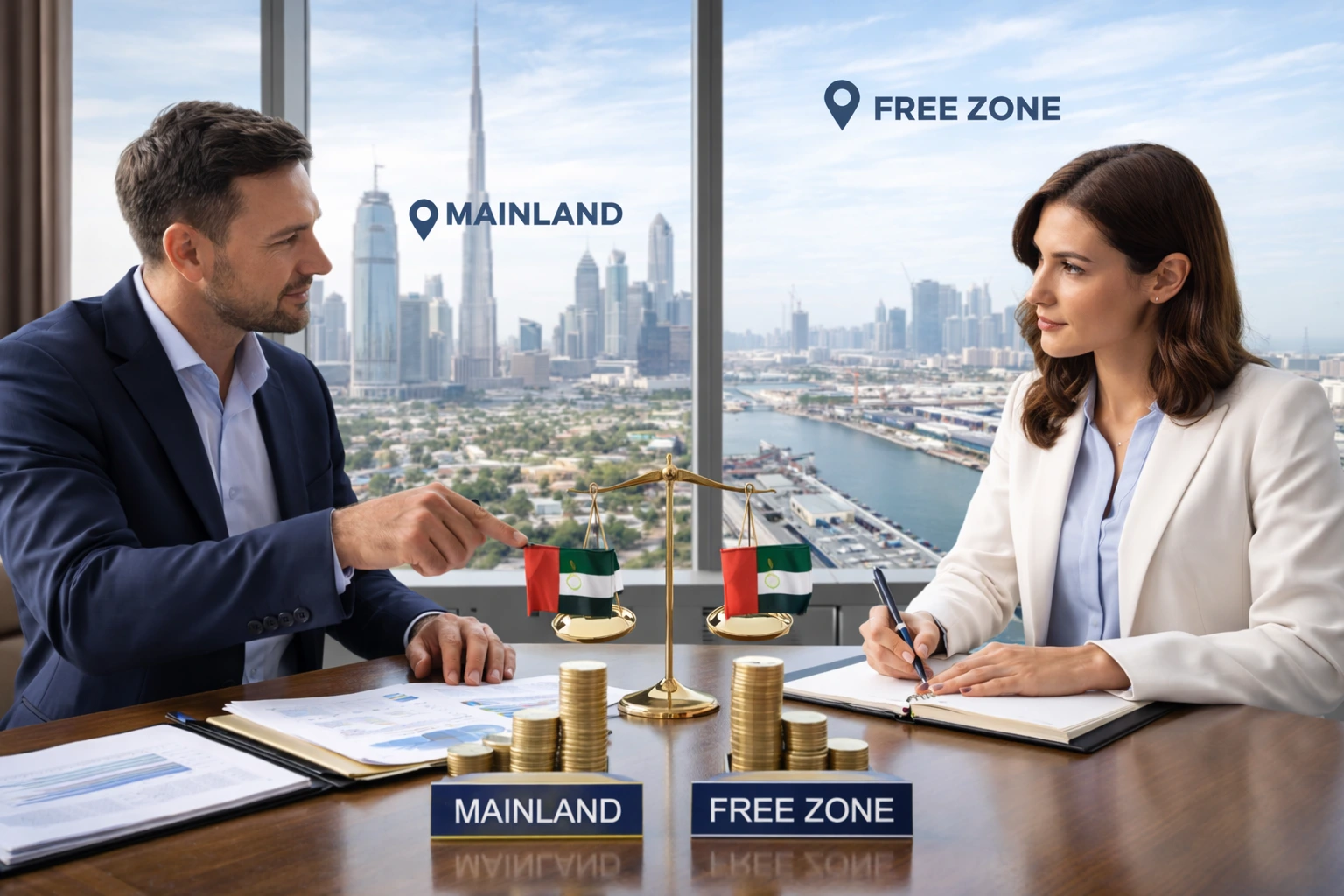
Mainland vs Free Zone Company Formation UAE (2025)
The core difference in mainland vs free zone company formation UAE comes down to where your business can operate and who regulates it: a mainland company, licensed by the Department of Economic Development (DED), trades freely across all seven emirates and internationally, while a free zone company, governed by its own Free Zone Authority, operates primarily within the zone and in global markets, with restrictions on direct mainland trade. As of 2025, both paths allow 100% foreign ownership for qualifying activities, yet they differ materially in cost structure, licensing flexibility, and market access. Choosing correctly at incorporation saves you from costly restructuring later.
Key Takeaways
- Mainland companies hold unrestricted trading rights across all UAE emirates, including eligibility for government contracts and direct B2C sales.
- Free zone companies offer streamlined setup, predictable renewal costs, and guaranteed 100% foreign ownership across all sectors without a local sponsor requirement.
- Following Federal Decree-Law No. 26 of 2020, most mainland activities now permit 100% foreign ownership, although certain strategic sectors still require local participation.
- Your trade license type determines your operating geography: mainland licenses grant broad domestic access; free zone licenses generally restrict you to the zone and international markets.
- The best jurisdiction depends on your business model: digital services and cross-border e-commerce often suit free zones, while retail, distribution, and manufacturing typically require mainland licensing.
Understanding the Two Jurisdictions
What Is a Mainland Company?
A mainland company is licensed by the Department of Economic Development (DED) in the relevant emirate. It operates under the primary commercial legislation of that emirate and federal UAE law.
Because the license is emirate-level rather than zone-specific, mainland entities can open offices, retail outlets, or warehouses anywhere within the emirate. They can also trade across all seven emirates and internationally without structural limitations.
Mainland formation suits businesses that depend on local customers, physical storefronts, domestic distribution, or government contract eligibility.
What Is a Free Zone Company?
A free zone company is established within one of the UAE’s 50-plus designated economic zones, each managed by its own Free Zone Authority. Notable examples include DMCC, JAFZA, IFZA, Meydan, RAKEZ, ADGM, and DIFC.
These zones were created specifically to attract international trade and foreign investment. Consequently, they offer benefits such as 100% foreign ownership, customs duty exemptions on imports and re-exports, and simplified licensing procedures.
Free zones are well suited for consulting firms, tech startups, e-commerce operators servicing international clients, and import/export businesses that do not need to sell directly to UAE consumers.
Why the Distinction Matters
Your jurisdiction choice is not merely an administrative decision. Instead, it functions as your operating map. It dictates where you can sell, how you recruit staff, what compliance obligations you face, and what you pay each year. Therefore, understanding the distinction before you incorporate is essential to avoiding expensive corrections down the line.
Ownership and Control: Mainland vs Free Zone
The Historical Barrier for Foreign Investors
For decades, mainland companies required a UAE national to hold at least 51% of the company’s equity. This mandatory local partnership structure deterred many foreign entrepreneurs who wanted full control over operations and profits.
The 2020 Reform: Federal Decree-Law No. 26
The UAE Government amended the Commercial Companies Law through Federal Decree-Law No. 26 of 2020. This landmark change allows foreign investors to hold up to 100% of mainland companies for most commercial activities. However, a limited number of strategic sectors still require Emirati participation, and emirate-level implementing decisions may apply. Always confirm your specific activity against the latest positive list published by the relevant DED.
Free Zone Ownership Guarantee
Free zone entities provide 100% foreign ownership across all sectors by design. There is no requirement for a local sponsor or service agent, which gives founders full equity retention from day one. For investors who want the clearest, most straightforward path to complete ownership autonomy, free zones remain the definitive option.
Practical Implications
Although mainland ownership rules have improved significantly, the structural guarantee of full foreign ownership in free zones eliminates any residual ambiguity. If equity control is your primary concern, a free zone removes that variable entirely. Conversely, if your business model demands mainland access, you can now, in most cases, achieve 100% ownership there as well. For tailored guidance on structuring your entity correctly, consider a professional corporate structuring review.
Scope of Operations: Where Can You Trade?
Mainland Trading Rights
Mainland companies hold the widest operational scope in the UAE. Specifically, they can:
- Conduct business across all seven emirates without geographic restriction.
- Engage in direct B2B and B2C transactions with local UAE customers.
- Open physical retail stores, distribution centres, and warehouses anywhere within the licensing emirate.
- Bid on government and semi-government contracts, a significant revenue channel for many sectors.
This breadth of access makes the mainland license the default choice for businesses that rely on a local customer base or physical infrastructure.
Free Zone Trading Boundaries
In contrast, free zone companies are generally limited to operating within their designated zone and conducting international trade. They cannot sell directly to mainland customers without an intermediary.
If a free zone entity wants to reach UAE consumers, it typically must appoint a locally licensed distributor, agent, or logistics partner. Requirements vary by activity, zone, and structure.
However, for businesses focused on international B2B services, cross-border e-commerce, or import/export logistics, these geographic restrictions are largely irrelevant. The zone itself becomes the operational base, while clients sit abroad.
Understanding the Dubai DED vs Free Zone Trade License
The licence you hold determines your operating geography. A DED trade licence grants broad domestic and international reach. A free zone trade licence, while efficient to obtain, confines your direct commercial activity to the zone and overseas markets. Before choosing, map your actual customer base and supply chain to the licence that matches.
Cost Comparison: Mainland vs Free Zone Setup
Cost transparency matters for every founder. Below is a side-by-side Dubai mainland vs free zone cost comparison across the three main expense categories.
| Cost Factor | Mainland Setup | Free Zone Setup |
|---|---|---|
| Initial Setup | Higher: requires a physical office lease, multi-agency approvals (DED, MOHRE, municipality), and document legalisation fees | Lower: bundled packages often include licence, visas, and flexi-desk; some zones offer rapid “Fawri” licences processed in under an hour |
| Ongoing Renewals | Variable: office lease fluctuations, visa fees tied to office size and employee quota | Predictable: fixed annual renewal packages with bundled visa allocations (commonly up to six visas) |
| Tax & Customs | Subject to federal corporate tax under FTA rules; standard customs duties apply | Extended corporate tax exemptions for qualifying activities; zero or reduced customs duties on imports and re-exports within the zone |
Initial Setup Costs
Mainland incorporation typically demands a higher upfront investment. You need a physical office (virtual offices are generally not accepted for DED licensing), approvals from multiple government departments, and professional document attestation. These requirements add both cost and time.
Free zones counter this with all-in-one packages. A single authority handles licensing, visa processing, and workspace allocation. Some zones, such as IFZA and Meydan, actively market rapid-formation timelines, and the Fawri licence concept allows certain activities to be licensed within 60 minutes.
Ongoing Operational Costs
Mainland companies face variable annual costs. Office lease renewals fluctuate with the property market, and visa quotas are linked to office square footage, which means scaling your team can require a larger (and costlier) office.
Free zones, by comparison, offer predictable fixed-fee renewals. Because visa allocations are bundled into the package, workforce planning becomes simpler and more budget-friendly.
Tax and Customs Considerations
Both mainland and free zone entities are subject to the UAE’s federal corporate tax framework, introduced in 2023. However, qualifying free zone persons may benefit from a 0% corporate tax rate on qualifying income, subject to meeting substance and compliance requirements set by the FTA. Additionally, free zone entities often enjoy customs duty exemptions on goods moving within and through the zone, a meaningful advantage for import/export businesses.
Industry-Specific Recommendations
E-Commerce and Digital Services
When deciding between mainland or free zone for an e-commerce business in the UAE, consider your fulfilment model. If you sell cross-border to international customers without local warehousing, a free zone licence offers speed, lower cost, and sufficient scope. If you warehouse locally, deliver to UAE addresses, or plan to pursue government e-commerce opportunities, mainland licensing is the stronger fit.
Similarly, SaaS companies, digital agencies, and tech startups often thrive in free zones because their clients sit globally and their operations are primarily remote.
Professional Services and Consulting
Independent consultants, marketing firms, and advisory practices are ideal free zone candidates. Their services are delivered remotely or internationally, which means geographic trading restrictions rarely affect revenue. The speed-to-market advantage of free zone formation also matters: less time on paperwork means faster client onboarding.
Retail, Distribution, and Manufacturing
Retail storefronts, broad distribution networks, and manufacturing facilities require mainland licensing. These operations need direct access to the local market, physical infrastructure across emirates, and the ability to move goods domestically without intermediary structures.
Decision Framework: Mainland or Free Zone?
Use the checklist below to match your business model to the right jurisdiction. Base the decision on what your business needs to do daily, not just what appears cheaper at the outset.
Choose Mainland If:
- You need to trade directly with local UAE customers (B2B or B2C).
- You plan to open physical retail locations across multiple emirates.
- You want to bid on government or semi-government contracts.
- You require a large on-the-ground team with a full-time physical presence.
- Your business depends on domestic distribution or warehousing.
Choose Free Zone If:
- Your business is primarily international or remote-based.
- You are launching a consultancy, digital service, or cross-border e-commerce operation.
- You prioritise fast setup, predictable costs, and streamlined compliance.
- You operate in import/export without needing local UAE distribution.
- You want guaranteed 100% foreign ownership with zero local partnership obligations.
If your situation falls between these two paths, or if you need to combine mainland and free zone entities within a single group, professional company formation advice can prevent structural mistakes that are expensive to unwind.
Next Steps
There is no universal answer to the mainland vs free zone question. The right choice depends on your target market, operational activities, visa requirements, and long-term growth plans.
Mainland formation delivers unrestricted local trading and a powerful physical footprint. Free zone formation provides international reach, speed, and cost efficiency. Many businesses ultimately benefit from a combination of both, using a holding structure or dual-licensing arrangement.
Before you incorporate, get a clear picture of your compliance obligations and ongoing costs. A legal consultation tailored to your specific activity and emirate ensures you start on the right foundation.
Frequently Asked Questions
What is the main difference between a mainland and a free zone company in the UAE?
A mainland company is licensed by the emirate’s DED and can trade freely across the entire UAE market, while a free zone company operates under a Free Zone Authority and is generally limited to business within its zone and international markets. To reach mainland customers, a free zone entity typically needs a locally licensed distributor or partner.
Can I own 100% of a mainland company as a foreign investor?
Yes, in most cases. Following Federal Decree-Law No. 26 of 2020, foreign investors can hold 100% of mainland companies for the majority of commercial activities. However, certain strategic sectors still require Emirati participation, and the exact rules depend on your licensed activity and the relevant emirate’s implementing decisions.
Do free zone companies need a local sponsor?
No. Free zone entities allow 100% foreign ownership by design, and there is no requirement for a local sponsor or service agent. This structural guarantee is one of the primary reasons founders choose free zone incorporation.
Can a free zone company sell directly to UAE customers?
Generally, no. A free zone company cannot trade directly on the mainland. To access local UAE consumers, it must typically work through a locally licensed distributor, agent, or logistics partner. The specific requirements vary by activity and free zone.
Which option is cheaper: mainland or free zone?
Free zones often appear more cost-effective upfront because they offer bundled packages that include the licence, visas, and workspace. Mainland setups tend to carry higher and more variable costs due to office lease requirements, multi-agency approvals, and visa quotas linked to office space. However, total cost depends on your specific business model and growth trajectory.
Which setup is best for e-commerce in the UAE?
A free zone licence suits cross-border e-commerce businesses with an international customer base and no local warehousing. A mainland licence is the better choice if you warehouse inventory locally, sell directly to UAE consumers, manage domestic deliveries, or plan to pursue government-related e-commerce opportunities.
Disclaimer: This article is for general informational purposes only and does not constitute legal, tax, or regulatory advice. Rules and fees in the UAE change frequently. Before acting on anything you read here, speak to a qualified advisor — we are happy to help.