
Dubai Real Estate Brokerage License: RERA Requirements, Steps & Costs
Dubai Real Estate Brokerage License (DED + RERA): Requirements, Steps, Costs, Timelines
Key Takeaways
Getting a Dubai real estate brokerage license is a compliance-first process governed by RERA and tied to your business licensing with Dubai’s Department of Economy and Tourism (as per Dubai’s Department of Economy and Tourism (DED)). Below are the key takeaways on requirements, the step-by-step pathway, and typical costs—so you can assess feasibility, timelines, and next actions with confidence.
- Start with RERA eligibility before you spend on setup: Confirm you meet RERA certification requirements (including required training/exams) early to avoid paying for company formation steps you can’t yet activate.
- Treat the DED license and RERA approvals as a linked workflow: A Dubai property broker license typically involves both business licensing (DED) and real estate regulatory requirements (RERA), so plan documentation and sequencing accordingly.
- Follow a step-by-step application path to reduce rework: Reserve a trade name, secure initial approvals, finalize legal structure and premises, obtain the DED license, then complete RERA-related registrations/certification to legally operate as a brokerage.
- Budget for more than “license fees” to get a true cost picture: The cost of a real estate brokerage license in Dubai often includes DED licensing fees, RERA certification/training costs, office/lease requirements, admin/service charges, and ongoing renewals.
- Plan timelines around approvals, not just paperwork: How long it takes depends on document readiness, exam/training schedules, and processing times across DED and RERA touchpoints.
- Prepare the documentation stack like a compliance file: Expect to compile identity/visa and company documents, tenancy/office details, and required certificates—missing items are a common reason applications slow down.
- Foreign ownership is possible, but structure matters: Foreigners can open a brokerage, but the optimal setup depends on your jurisdiction, activities, and regulatory obligations under RERA and DED rules.
With these fundamentals in place, the next sections walk through the exact RERA requirements, the full licensing steps in order, and a practical breakdown of expected costs—so you can move from research to execution efficiently.
Contents
- RERA vs DED: How Dubai Brokerage Licensing Works
- RERA Eligibility & Core Regulatory Requirements
- Business Setup Decisions That Affect Approval
- Step-by-Step: How to Get a Real Estate Brokerage License in Dubai
- Documentation Checklist: Build a “Compliance File”
- Costs & Fees: True Budget
- Timelines: How Long It Takes
- Foreign Founders: Ownership, Residency, Substance
- Operational Compliance After Licensing
- Conclusion: A Future-Focused Takeaway
Why Most Brokerage License Applications Get Delayed (And How to Avoid It)
Most applicants don’t get delayed by paperwork—they get delayed by sequencing RERA eligibility and DED licensing in the wrong order. If you’re serious about entering Dubai’s property market, a Dubai real estate brokerage license is a compliance-first pathway where training, exams, approvals, and business setup are tightly connected—and mistakes can turn into avoidable costs and weeks of rework.
This guide shows how to get a real estate brokerage license in Dubai with clarity: the RERA certification requirements to confirm before spending on setup, the step-by-step workflow that links your DED license to RERA approvals, and the full cost picture beyond “license fees” (including training, office requirements, admin charges, and renewals). You’ll also see how timelines typically move in practice and what foreign founders should consider when choosing the right structure (see what foreign founders should consider when choosing the right structure).
Practical rule: If you can’t explain your licensing sequence (RERA eligibility → DED licensing → post-license RERA onboarding) in one page, you’re likely to pay for avoidable rework.
Now, let’s connect the dots between the two systems that define your legal ability to operate: DED for business licensing and RERA/DLD for regulated brokerage activity.
RERA vs DED: How Dubai Brokerage Licensing Works (Linked Workflow)
What “Dubai real estate brokerage license” actually includes
A “Dubai real estate brokerage license” is not a single approval. It is a linked workflow where you typically need:
- A commercial/company license issued by the relevant business licensing authority (commonly referred to as the DED license Dubai for mainland setups), covering the correct real estate brokerage activity under the DED framework.
- RERA-facing permissions (through the Dubai Land Department (DLD) and RERA frameworks) that allow the business and its practitioners to operate compliantly, including individual competency requirements (commonly referred to as RERA certification) and operational registrations (see Dubai Land Department (DLD)).
In practical terms, when operators ask how to get a real estate brokerage license in Dubai, they are really asking how to align company formation + activity licensing with real estate regulator requirements so the brokerage can legally market, mediate, and transact.
Why RERA eligibility should be confirmed before company setup spend
Many founders spend on trade name reservation, office leases, visas, and incorporation before confirming whether key personnel can satisfy RERA eligibility and competency requirements. That can lead to sunk costs if:
- the intended manager/broker does not meet required competency or documentation standards,
- training/exam scheduling creates delays that make an office lease prematurely expensive, or
- activity/structure choices later conflict with what the regulator expects for brokerage operations.
A safer approach is to validate the human and compliance side early (who will act as manager/authorized signatory, who will hold broker cards, how listings/escrow/advertising will be controlled) before committing to the highest fixed costs.
Typical sequencing: RERA certification touchpoints vs DED license Dubai steps
While exact sequencing can vary based on structure and the team’s readiness, the typical workflow looks like this:
- Pre-check RERA-facing eligibility and staffing plan (who will be licensed/certified and operationally accountable).
- Set up the company with the correct activity on the business license (often mainland via DED for on-the-ground brokerage operations) via DED.
- Complete post-license RERA/DLD registrations and individual requirements so the firm and its agents can operate (e.g., broker cards and system access where applicable).
- Go live only after your advertising, onboarding, recordkeeping, and AML controls are in place.
Key compliance risks when RERA and DED steps are done out of order
Doing steps out of sequence can create avoidable compliance and commercial risks:
- Activity mismatch risk: If the DED license activity wording does not align with brokerage operations, you may face delays in RERA-facing onboarding or limitations on what the company can lawfully do.
- Operating too early: Marketing properties, collecting client funds, or signing brokerage agreements before the right RERA-facing permissions and staff credentials are active can expose the business to complaints, fines, or suspension risks.
- Cost leakage: Locking into office leases and hiring before the training/exam path is scheduled increases burn rate during the most approval-dependent phase.
With the workflow clarified, the next step is to confirm whether your people and planned operating model can meet RERA’s baseline eligibility and conduct expectations.
RERA Eligibility & Core Regulatory Requirements (Start Here)
Who can apply: individual eligibility, residency/visa considerations, and fit-and-proper expectations
RERA-facing requirements are ultimately about competency, accountability, and traceability. Even where a company holds a license, the regulator will scrutinize the individuals running day-to-day brokerage activity (manager, partners, and brokers).
At a practical level, plan for these eligibility dimensions:
- Identity and status: valid identification and lawful status in the UAE where relevant to your role and setup.
- Role clarity: who is the designated manager/principal, who are registered brokers, and who is authorized to sign/submit regulator-facing requests.
- Fit-and-proper expectations: the regulator may evaluate professionalism, integrity signals, and whether the applicant can follow regulated conduct (e.g., client handling, advertising discipline, dispute cooperation).
If you are building around a “star broker” or external manager, validate early that the person can commit time for training/exams and can be consistently available for compliance accountability.
RERA certification requirements: training, exams, and minimum competency standards
In Dubai brokerage operations, “RERA certification” is commonly used to describe completing the relevant training and exam pathways that demonstrate minimum competency in areas such as:
- brokerage ethics and professional conduct,
- listing and advertising rules,
- transactional processes and documentation,
- client money handling expectations (where applicable), and
- anti-money laundering (AML) awareness and reporting discipline.
Because training and exam dates can be a bottleneck, treat them as a schedule constraint in your project plan. If you need multiple brokers onboarded, do not assume all candidates will clear exams on the first attempt—build time for retakes and document re-submissions.
Requirements for a RERA broker card (what it is and when it’s needed)
A RERA broker card is an individual credential used to show that a person is authorized to act as a real estate broker under the relevant Dubai regulatory framework. It is typically needed for practitioners who will:
- represent the brokerage in client-facing brokerage activities,
- market and negotiate deals in a broker capacity, and
- access certain operational workflows where regulated access is tied to individual identity.
From an operational standpoint, treat the broker card as a go/no-go control for client-facing brokerage work: even if the company is formed, your staff should not be presented as “brokers” publicly unless their status is correct and current.
Brokerage conduct and real estate regulatory requirements you must be ready to follow from day one
Regulators focus on whether brokerages can consistently meet real estate regulatory requirements at scale. Day-one readiness usually includes:
- Written client onboarding and KYC checks appropriate for real estate transactions.
- Clear fee and scope disclosures: what you do, who you represent, and how you are paid.
- Controlled advertising and listings with documented permissions and accurate property information.
- Recordkeeping discipline: signed agreements, ID/KYC files, communications, and transaction files retained in an organized way.
- Complaint handling and escalation: the ability to respond quickly with a complete audit trail.
If your business model relies heavily on lead generation and high-volume listings, your compliance controls must be designed for throughput—manual, ad-hoc controls tend to fail under volume.
Common reasons applicants fail or get delayed at the RERA stage
Delays tend to come from operational gaps rather than a single missing form. Common issues include:
- Unclear roles: no confirmed manager/principal accountable for brokerage conduct.
- Training/exam misalignment: candidates registered late, missed sessions, or incomplete prerequisites.
- Documentation gaps: inconsistent names, expired IDs, missing attestations/translations where needed.
- Compliance unpreparedness: inability to explain how client onboarding, advertising approvals, and recordkeeping will be managed.
Once you are confident the team can meet RERA-facing requirements, the next step is choosing a company setup that won’t conflict with licensing and operational permissions.
Business Setup Decisions That Affect Approval (Before You Apply)
Choosing legal structure and ownership setup (foreign ownership is possible, structure matters)
Foreign ownership is often possible, but the right structure depends on how you will manage control, visas, banking, and regulatory accountability. When selecting a structure, pressure-test:
- Who will be the manager on the license and in practice (and whether they can meet RERA competency expectations).
- Residency of owners: residents vs non-residents affects signature logistics and day-to-day substance (who can appear, sign, and manage operations).
- Governance: decision rights, partner exits, and how you maintain continuity if a key manager leaves.
Avoid building a structure that only “works on paper.” Brokerages are operationally scrutinized; your structure must support real supervision, not just ownership.
Defining the correct business activities on the DED license (avoid activity mismatch with RERA)
The activity wording on your business license is not a formality—it frames what you are legally allowed to do and what regulators expect you to do. To reduce friction:
- Choose activity descriptions that clearly map to brokerage (not just “real estate services” broadly).
- Avoid mixing unrelated activities that complicate compliance (e.g., adding multiple business lines without operational separation).
- Ensure your intended revenue streams (sales, leasing, brokerage commissions, ancillary services) align with licensed activities.
An activity mismatch is one of the most preventable causes of rework, especially when you later apply for RERA-facing operational onboarding (see how to add a business activity).
Mainland vs other jurisdiction considerations (what typically aligns best with brokerage operations)
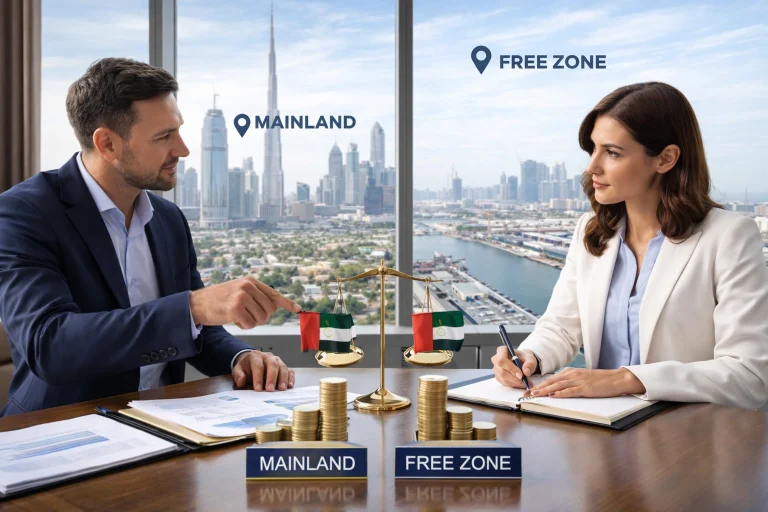
Most brokerages that want to operate broadly in Dubai and interact with local market infrastructure tend to favor a mainland setup (see mainland vs free zone company formation), because it typically aligns with:
- local operational presence expectations,
- leasing/office realities (Ejari), and
- common counterparties’ onboarding preferences (developers, landlords, banks).
Other jurisdictions may be relevant for certain business models (e.g., advisory, international marketing), but if you are doing hands-on brokerage activity inside Dubai, prioritize the setup that minimizes operational friction and regulator-facing complexity.
Office/premises requirements: Ejari/tenancy, suitability, and compliance implications
Office decisions affect both approval timing and ongoing compliance cost. Plan for:
- Tenancy contract + Ejari (where applicable) as a core file for licensing and renewals.
- Premises suitability: space to store records securely, meet clients, and operate a professional brokerage environment.
- Cost control: locking in a long lease too early can create cash pressure if training/exams or approvals slip.
If you intend a lean operation, validate whether a small office can meet practical expectations for recordkeeping, client meetings, and audit readiness before committing.
Banking, AML, and operational readiness basics regulators expect brokerages to maintain
Real estate is an AML-sensitive sector. Even before your first transaction, you should be ready to demonstrate:
- a basic AML policy and staff awareness,
- a defined onboarding process for clients (buyers, sellers, landlords, tenants),
- escalation steps for unusual transactions, and
- an organized transaction file structure that can be produced quickly if asked.
A useful rule: if you cannot explain your onboarding and recordkeeping process in one page, you are not ready to scale compliantly.
Cross-industry compliance lesson (why this works)
The same “compliance file” mindset that speeds up brokerage approvals also powers regulated operations in other sectors:
- Healthcare: patient onboarding and auditable documentation reduce delays in insurance approvals and clinical governance.
- Finance: KYC/AML workflows and transaction monitoring reduce account freezes and fraud exposure.
- Legal: clear authorization letters and retention discipline protect privilege, reduce disputes, and streamline compliance checks.
- Education: documented processes and role clarity improve student safeguarding, accreditation readiness, and incident response.
- Retail: structured approvals and recordkeeping support inventory controls and reduce shrinkage.
- Environmental science: clean data provenance and version control improve auditability of climate models and reports.
With strategic setup decisions made, you can execute the licensing process efficiently—provided you follow the correct sequence across DED and RERA touchpoints.
Step-by-Step: How to Get a Real Estate Brokerage License in Dubai (DED + RERA)
Step 1: Confirm RERA eligibility and map your compliance plan (training/exam schedule, required roles)
Before spending heavily, confirm:
- who will be the licensed manager/principal and which individuals need RERA certification,
- the training/exam schedule and document prerequisites, and
- the compliance blueprint: onboarding, listing controls, advertising approvals, complaint handling, AML basics.
This is the first de-risking step because it determines whether the rest of the setup is viable.
Step 2: Reserve trade name and confirm permitted activities (Dubai property broker license alignment)
Reserve a trade name that fits naming rules and branding needs, then confirm the exact activity that matches brokerage operations. Do not treat this as an administrative checkbox—your “Dubai property broker license” positioning must match the licensed activity to avoid downstream confusion with banks, portals, and regulator-facing onboarding.
Step 3: Apply for initial approvals and prepare the incorporation file
Initial approvals commonly include baseline acceptance of:
- shareholders/ownership structure,
- manager appointment intention, and
- the proposed business activity and name.
At this stage, start assembling a clean incorporation file (IDs, visas/status documents where relevant, and any required attestations/translations). Small inconsistencies (name spelling, expired documents, unclear addresses) can create avoidable cycles later.
Step 4: Finalize legal structure, MOA/LSA (if applicable), and shareholder/manager appointments
Finalize the constitutional documents and appointments that define:
- who can sign and bind the company,
- profit/ownership rights, and
- manager authority for day-to-day operations and compliance.
If an LSA or similar local service arrangement is relevant to your structure, ensure it is consistent with operational reality—regulators and banks dislike arrangements where control and accountability are ambiguous.
Step 5: Secure office lease/Ejari and any premises-related approvals
Once your eligibility and initial approvals are on track, secure premises and complete the tenancy/Ejari file (as applicable). Choose an office plan that supports secure storage for records, professional client engagement, and manageable costs while the brokerage ramps up.
Cost control tip: Avoid signing an expensive lease before you have confidence in training/exam timing and final licensing milestones.
Step 6: Submit and obtain the DED license Dubai (business licensing milestone)
Submit the final application and pay the relevant licensing fees to obtain the business license. This milestone establishes the legal entity and permitted activities, but it does not automatically mean you can transact as a fully operational brokerage without completing RERA-facing steps (see how to get a DED trade license).
Step 7: Complete RERA-related registrations/certifications to operate as a brokerage (post-DED workflow)
After the company is licensed, complete the regulator-facing onboarding required for actual brokerage operations, typically including:
- completion/validation of RERA certification for required individuals,
- arranging broker cards for active brokers, and
- registering the brokerage and its practitioners in the relevant systems/workflows used for regulated operations.
Treat this as the operational activation layer of your RERA brokerage license journey—this is where many “licensed but not yet operational” brokerages get stuck due to missing certificates or unclear staffing structures.
Step 8: Activate brokerage operations compliantly (systems, templates, and staff readiness)
Before your first live listing or client engagement at scale, implement:
- client onboarding/KYC forms and workflows,
- template brokerage agreements and disclosure language,
- listing intake checklists (permission, property details, photo/marketing consent),
- recordkeeping structure (digital folders, retention discipline), and
- staff onboarding (what to say, what not to promise, escalation rules).
Mini-case (qualitative): A new brokerage that standardized listing permissions and ad approvals before launch avoided repeated rework when portals and counterparties requested proof of authorization, allowing the team to focus on transactions instead of chasing missing paperwork.
Step 9: Final checks before transacting (broker card status, permissions, and public-facing compliance)
Do a final operational audit:
- Are all client-facing brokers’ broker cards valid and current?
- Is your public advertising consistent with licensed activity and disclosure expectations?
- Are client funds handling practices clear, documented, and controlled?
- Can you produce a complete file for a sample transaction within minutes?
Only once these are true should you scale marketing and start accepting a high volume of client mandates.
With the workflow established, your next risk-reduction tool is building a clean documentation “compliance file” so you don’t lose time to avoidable re-submissions.
Documentation Checklist: Build a “Compliance File” to Prevent Rework
Identity and immigration documents (owners, managers, authorized signatories)
Prepare consistent, up-to-date copies of:
- passports and IDs,
- visa/residency status documents where relevant,
- proof of address/contact details (as commonly requested by banks and service providers), and
- specimen signatures (where used in forms/authorizations).
Keep names consistent across documents (including spacing and spelling) to avoid “same person, different name” rejections.
Company formation documents (trade name, initial approvals, MOA, license, shareholder papers)
Maintain a master folder with:
- trade name reservation certificate,
- initial approval documents,
- MOA and any side agreements relevant to control/authority,
- final business license, and
- shareholder resolutions/manager appointment documents.
For multi-partner brokerages, also keep an internal “governance pack” that clarifies who can approve hiring, marketing spend, and client money processes.
Tenancy and premises file (Ejari, office details, NOCs where required)
Create a premises file that includes:
- tenancy contract,
- Ejari (where applicable),
- office location map/contact, and
- any building management letters/NOCs that are required for signage or operational needs.
This file becomes critical not only for licensing but also for banking and renewals.
RERA certification and exam records (certificates, proof of completion, IDs)
Keep a clean record set for each practitioner:
- training completion confirmations,
- exam results/certificates (as issued), and
- identification documents used for registration.
Store these per person, plus a summary sheet showing who is cleared for what role and when renewals are due.
Authorization letters, power of attorney, and third-party service provider documents (if used)
If you use a PRO, consultant, or law firm, file:
- signed authorization letters,
- POAs (if any), and
- scope-of-work and responsibility matrices (who does submissions, who holds originals, who receives regulator communications).
Operationally, this prevents a common failure mode: founders believing an agent “handled it” when a submission actually required a director signature or updated ID.
Most commonly missing documents that slow approvals
The most frequent sources of rework include:
- expired IDs or mismatched names across files,
- missing manager appointment papers,
- incomplete tenancy/Ejari details, and
- missing training/exam proof for the individuals intended to act as brokers.
Once your documentation is tight, you can budget accurately—because costs in this process are driven as much by rework and delays as by official fees.
Costs & Fees: True Budget for a Dubai Real Estate Brokerage License
DED licensing fees and typical government charges (initial + annual renewal)
DED-related costs generally include:
- trade name reservation and initial approval charges,
- license issuance fees, and
- annual renewal fees.
Typical ranges vary materially by activity selection, legal structure, and any additional approvals linked to the business model. Build a buffer for re-issuance/re-typing cycles if names/activities change mid-process.
RERA certification costs: training, exam fees, and any required registrations
RERA certification and related steps can include:
- training/course fees,
- exam/assessment fees, and
- registration/processing fees tied to issuing individual credentials (e.g., broker cards).
Costs scale with headcount: a brokerage planning multiple agents should budget per person, not as a one-time company cost.
Office/lease costs: rent, Ejari, deposits, fit-out, and ongoing utilities
Office costs are often the largest non-government cost driver, including:
- rent and security deposits,
- Ejari and related registration charges,
- basic fit-out, furniture, and IT, and
- utilities and internet.
The variance is driven by location, size, and the standard you need for client-facing operations. If you intend a premium brand, budget for a more formal reception and meeting environment; if you intend a lean model, focus on compliance adequacy and secure recordkeeping.
Administrative/service charges: typing centers, PRO support, attestations, translations, couriering
Even with a straightforward setup, expect recurring administrative outlays for:
- typing center submissions and forms,
- attestations/legalization where required for foreign documents,
- legal translation (where needed), and
- couriering/scanning/printing.
These are usually not the largest line items, but they become significant when rework occurs (e.g., repeated attestations due to document format errors).
Staff-related compliance costs: hiring, visas, onboarding, and role-based certification
If your operating model depends on employed staff, budget for:
- recruitment and onboarding time,
- visas/work permits where applicable (MOHRE) via MOHRE services, and
- ongoing training and certification maintenance for brokers and managers.
Even if agents are commission-based, you still incur compliance costs for training, supervision, and maintaining clean personnel files.
Ongoing renewals and recurring compliance costs (RERA brokerage license maintenance)
A sustainable budget accounts for recurring obligations:
- annual license renewals (see Dubai trade license renewal),
- tenancy/Ejari renewals and office costs,
- updating broker cards/certifications as required, and
- compliance tooling (secure storage, CRM controls, AML screening tools if used).
Treat compliance as an operating cost, not a one-time setup expense—especially as transaction volume grows.
Practical budgeting ranges and what drives variance (activities, office size, number of brokers, service model)
Because exact fees vary by structure and operational choices, use a range-based approach and model variance drivers:
- Service model: boutique advisory vs high-volume brokerage changes staffing and compliance tooling needs.
- Headcount: more brokers increases certification, broker card, onboarding, and supervision costs.
- Office footprint: larger or prime locations increase rent, deposits, and fit-out.
- Document readiness: clean documents reduce paid re-submissions and delay-related overhead.
A helpful control is to build two budgets: a minimum viable compliant model and a growth-ready model, then phase upgrades only after approvals and early revenue validation.
Once you know what you might spend, you need to know how long the process can take—because timelines are where budgets often break.
Timelines: How Long It Takes to Get a Real Estate Brokerage License in Dubai
Timeline drivers: document readiness, exam/training schedules, and processing times
The timeline is driven less by the licensing form itself and more by:
- how quickly owners/managers can produce complete, consistent documents,
- availability of training and exam slots for RERA certification, and
- iteration cycles if authorities request clarifications.
If you have multiple shareholders in different countries, signature logistics and attestations can become a critical path.
Typical best-case vs realistic timelines (where bottlenecks usually occur)
A best-case path happens when eligibility is clear, documents are clean, and training/exam timing aligns with your incorporation schedule.
A more realistic timeline includes delays from:
- scheduling training/exams and waiting for results,
- office lease/Ejari coordination, and
- activity/name adjustments after feedback from authorities or banks.
Rather than chasing an exact number of days, manage to milestones and avoid starting cost-heavy commitments until the upstream milestone is confirmed.
How to shorten timelines without increasing rejection risk (sequencing and pre-checks)
You can reduce elapsed time by improving sequencing:
- Pre-check documents for consistency (names, dates, signatures).
- Lock your activity selection early to avoid rework.
- Schedule training/exams as soon as you confirm who will be the manager/brokers.
- Prepare your compliance file in parallel with incorporation steps.
Speed is safest when it comes from better preparation, not from skipping requirements.
When to pause spending and re-validate eligibility (cost-control decision points)
Use “pause points” to avoid cost leakage:
- Before signing a long office lease: confirm training/exam dates and initial approvals.
- Before hiring multiple brokers: confirm your operational registrations and supervision plan.
- Before launching advertising spend: confirm broker card status and listing permission workflows.
These checkpoints keep your burn rate aligned with regulatory progress.
With timelines understood, foreign founders should evaluate an additional layer: ownership, residency, and operational substance expectations.
Foreign Founders: Can Foreigners Open a Real Estate Brokerage in Dubai?
Ownership and control: what’s commonly allowed and what must be structured carefully
Yes, foreigners can often open and own a brokerage, but the key is ensuring control and accountability are structured in a way that supports:
- a locally functional management layer,
- reliable signing authority for regulatory and banking needs, and
- continuity if a founder is abroad for extended periods.
Avoid structures where the “real manager” is offshore and the onshore manager is only nominal—this increases operational and compliance risk.
Choosing the right setup for non-residents vs residents (visa pathway implications)
Residents typically have an easier time with day-to-day signing and document handling, banking onboarding, and operational supervision expectations.
Non-residents can still proceed, but should plan early for:
- who will act as authorized signatory locally,
- how visas (for owners and staff) will be managed if needed, and
- how the business will demonstrate real operational control in Dubai (see UAE company setup steps for non-residents).
Cross-border considerations: tax residency, banking, and operational substance expectations
Cross-border founders should coordinate:
- personal and corporate tax residency positions (with professional advice),
- bank account strategy and expected onboarding requests, and
- substance signals (office, management presence, documented decisions).
Banks and counterparties often focus on clarity of ownership, source of funds, and who controls transactions—prepare for deeper questions than a typical trading company might face.
Compliance expectations for overseas owners (authorized signatory, governance, and audit trails)
Overseas owners should ensure:
- documented governance (board/shareholder resolutions, delegated authorities),
- clear approval thresholds for high-risk transactions and refunds, and
- auditable trails of decisions and client communications.
Mini-case (qualitative): A foreign-owned brokerage reduced onboarding friction by appointing a locally present, properly authorized manager and documenting delegated signing limits, which improved response time to compliance queries from banks and counterparties.
Once ownership structure is clear, the most important work begins: running the brokerage without triggering penalties, complaints, or operational blocks.
Operational Compliance After Licensing (Avoid Penalties and Disruptions)
Brokerage policies you should implement immediately (client onboarding, recordkeeping, complaint handling)
Implement a minimal but effective policy suite:
- Client onboarding/KYC policy: what you collect, when, and how exceptions are handled.
- Recordkeeping policy: what goes in each transaction file and retention discipline.
- Complaints handling: acknowledgment timelines, internal escalation, and documentation.
Keep policies short and usable—staff follow what they can understand quickly.
Advertising and listing compliance basics (permissions, disclosures, and audit readiness)
Advertising is a frequent compliance pressure point. Operational controls should ensure:
- you have documented permission to market each listing,
- marketing claims are accurate and not misleading, and
- required disclosures and identification (where applicable) are consistently used across portals and social media.
Build an approval workflow so agents cannot publish listings without compliance checks (even a simple checklist and manager approval can prevent repeated issues).
AML and transaction monitoring essentials for real estate firms
Your AML foundation should include:
- risk-based client screening (including higher scrutiny for complex ownership or high-risk profiles),
- monitoring for unusual payment patterns and third-party payers, and
- escalation and reporting discipline aligned to UAE expectations (UAE FIU goAML) via goAML.
Operationally, AML success comes from consistency: the same checks done every time, not heroic intervention only when something feels wrong.
Changes that require updates/approvals (owners, manager, address, activities)
Brokerages often forget that changes can require formal updates. Plan governance and a change log for:
- ownership transfers or partner exits,
- manager replacement,
- office relocation/address updates, and
- activity amendments on the trade license (see trade license activity amendments).
Treat changes as regulated events—unreported updates can create renewal problems or regulatory disputes later.
Renewal calendar: DED renewals, RERA-related renewals, and ongoing certification requirements
Maintain a renewal calendar that tracks:
- business license renewal dates,
- tenancy/Ejari renewal milestones,
- broker card/certification renewals (per individual), and
- any recurring compliance training you require internally.
Renewal discipline is a competitive advantage: lapses can freeze operations, disrupt listings, and damage relationships with clients and developers.
Conclusion: Treat Compliance as Your Growth Engine
Getting a “Dubai real estate brokerage license” is less a single application and more a coordinated workflow: align your DED company license and activity wording with the RERA/DLD operational layer that governs who can practice, how you market, and how you transact (see Dubai Land Department (DLD)).
The most expensive mistakes come from sequencing—spending on leases, hiring, and branding before confirming RERA eligibility, training/exam timelines, and the staffing model that will carry day-to-day accountability. Done correctly, licensing becomes a predictable project: lock roles early, keep documents clean, build a compliance file, and activate operations only when broker cards, advertising controls, KYC/AML, and recordkeeping are ready to withstand scrutiny at scale.
Future-focused challenge: Dubai’s real estate ecosystem is becoming more data-driven and audit-ready—portals, banks, developers, and regulators increasingly expect proof, timestamps, and consistent disclosures. Brokerages that invest early in standardized onboarding, controlled advertising, and clean transaction files won’t just “stay compliant”—they will close faster, scale safer, and win trust earlier. If you want speed without setbacks, optimize preparation—not shortcuts—and treat compliance as the operating system of your brokerage, not a final checkbox.
FAQ
What are the requirements for opening a real estate brokerage in Dubai?
At a high level, the requirements include: a company license with the correct brokerage activity (commonly via DED license Dubai for mainland operations) under Dubai’s Department of Economy and Tourism (DED); qualified individuals meeting RERA certification expectations (training/exams as applicable); the ability to issue/maintain individual credentials such as a RERA broker card for client-facing brokers; an office/premises arrangement that supports compliant operations (including Ejari where applicable); and operational controls for advertising, recordkeeping, client onboarding, and AML discipline.
What are the requirements for a RERA broker card?
While specific document lists can vary by applicant and role, the practical requirements typically include: completion of required training and passing any required exams (often referred to as steps to get RERA broker certification), valid identification and status documents, and linkage to a properly licensed brokerage with the right operational permissions. Because the broker card is individual-specific, maintain a per-broker file and renewal tracking.
What is the cost of a real estate brokerage license in Dubai (all-in)?
The all-in cost is best estimated as a combined budget across: DED/company licensing and renewals; RERA training/exams and broker card-related processing (scaled by number of brokers); office rent/deposits/Ejari and fit-out; visas (if applicable); and admin costs (typing, attestations, translations). Costs vary most by office footprint, headcount, and how much rework occurs due to document or activity mismatches—build a contingency buffer.
What are the steps to get RERA broker certification?
Common steps include: identify who needs certification (manager/practicing brokers) based on your operating model; register for the required training and schedule exams early; prepare consistent identity documents for registration; pass the assessments and retain certificates/results in a compliance file; and use the certification records to support broker card issuance/renewal processes where needed. Treat this as a project plan item—not a last-minute task after the company is formed.
How long does it take to get a real estate brokerage license in Dubai?
Timing depends on training/exam scheduling, document readiness, office/Ejari timing, and how many correction cycles occur. Best-case scenarios occur when eligibility is confirmed early and documents are clean; realistic plans should include buffer time for training dates, clarifications, and administrative iteration.
Can foreigners open a real estate brokerage in Dubai, and what structure is best?
Foreigners can often open a brokerage, but the best structure depends on residency, operational control, and signing authority needs. Resident founders typically have smoother execution; non-residents should plan for locally present management/authorized signatories and strong governance documentation to satisfy operational and banking expectations.
Two common decision profiles are:
- Solo broker / small team: Lean office sized for compliance + meetings; limited headcount; founder-manager heavily involved; certification load limited to a few individuals. Main cost drivers are office and base licensing.
- Multi-agent brokerage: Larger office to support supervision, training, and records; dedicated manager/admin/compliance coordination becomes important; certification scales per broker and renewal tracking becomes critical. Main cost drivers are headcount, training/exams, visas, and supervision systems.
Before moving from plan to payments, use simple checkpoints: before committing to a long lease, confirm RERA training/exam schedule; before hiring a large team, confirm your post-DED RERA onboarding path; before heavy marketing spend, confirm broker card status and listing permission controls.