
How to Get a DED Trade License in Dubai: Steps, Costs & Requirements
DED Trade License in Dubai (Mainland): Steps, Documents, Costs, Timelines, and Status Tracking
Key Takeaways
Getting a DED trade license is a core step in setting up a mainland business in Dubai, but the process is often misunderstood due to confusing cost ranges, license-type differences, and varying approval timelines. Below are the key takeaways to help you understand how to get a trade license in Dubai DED, what documents you’ll need, what it typically costs, and how long each stage can take.
- Pick the right license first to avoid rework: Your activity determines whether you need a commercial vs professional trade license in the UAE (or industrial), and choosing incorrectly can trigger additional approvals, amended applications, and delays.
- Map your activity to the correct authority early: Dubai mainland licensing is typically via DED, while the Abu Dhabi trade license issuance process follows different authority workflows—confirm jurisdiction before reserving a name or drafting documents.
- Follow the DED sequence to keep approvals moving: The trade license Dubai process generally flows from activity selection and trade name reservation → initial approval → tenancy/lease steps → external approvals (if applicable) → license issuance and payment.
- Treat “documents required” as a checklist, not a suggestion: Common documents required for a Dubai trade license include passport/Emirates ID (as applicable), entry status, NOC (if applicable), trade name certificate, initial approval, MoA/LSA arrangements where required, and tenancy/Ejari—missing items are a top cause of resubmissions.
- Plan for external approvals based on business type: Certain activities (e.g., industrial, regulated trading, some professional services) require additional government or sector approvals; these are often the real driver behind longer processing times.
- Use timelines as a planning tool—not a guess: While many applications can progress quickly, DED processing time can range from a few days to several weeks depending on activity risk level, external approvals, tenancy readiness, and document completeness—build schedule buffer accordingly.
- Budget beyond the headline license fee: When asking “how much does a general trading license cost in Dubai,” factor in not only DED issuance fees but also name reservation, initial approval, tenancy/Ejari, and any third-party approvals—total cost varies based on structure and activity.
Contents
- Determine Your Jurisdiction: Dubai Mainland (DED) vs Other Emirates
- Choose the Right License Type (Avoid Rework and Delays)
- Pre-Application Planning (Before You Touch the DED Application)
- Step-by-Step: How to Get a Trade License in Dubai DED
- Documents Required for Dubai Trade License (Checklist by Scenario)
- External Approvals and Special-Case Requirements (What Adds Time)
- Costs: What You’ll Actually Pay (Beyond the Headline Fee)
- Timelines: How Long DED Trade License Approval Takes
- How to Check Trade License Status in UAE (Avoid Silent Delays)
- Common Mistakes and How to Avoid Them
- Post-Issuance Next Steps (Operational Readiness)
- Conclusion: A Future-Focused Licensing Strategy
A Clear View of the DED Licensing Journey
Getting a DED trade license in Dubai is rarely “just a formality”—it’s a sequence of decisions where one wrong selection can reset your application, extend approvals, and inflate the final bill. If you’re trying to figure out how to get a trade license in Dubai DED, the real complexity usually sits in three places: choosing the correct activity and legal form, preparing the right paperwork the first time, and accounting for costs beyond the headline fee.
This guide clarifies the full trade license Dubai process—from activity selection and name reservation to initial approval, tenancy/Ejari, external approvals, and final issuance—so you understand:
- the documents required for Dubai trade license applications (and how to avoid resubmission loops),
- what drives approval timelines in practice, and
- how to think about total cost when asking “how much does a general trading license cost in Dubai?”
Most DED licensing delays are preventable. They’re usually caused by mismatched activity codes, incomplete documents, tenancy/Ejari gating issues, or overlooked external approvals—not the final payment step.
To keep everything predictable, start with the foundation: jurisdiction. Once you know which authority governs your setup, every next step becomes simpler, faster, and easier to budget.
Determine Your Jurisdiction: Dubai Mainland (DED) vs Other Emirates
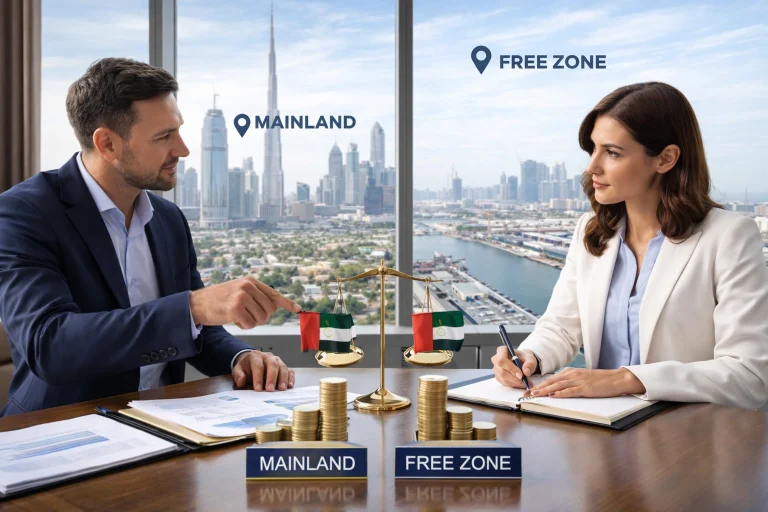
A Dubai mainland (DED) business license is typically the right path when you need to trade or provide services across the UAE market without being limited to a specific free zone’s rules, and when your operational footprint (office, warehouse, shop, or client sites) is primarily in Dubai. Mainland licensing is also commonly chosen when you need broader access to customers, certain government or semi-government tenders, and more flexibility on premises type (subject to activity requirements).
By contrast, a free zone license is often selected when you mainly operate within a free zone ecosystem or internationally, want a packaged setup, or prefer a jurisdiction with a narrower, pre-defined activity list. Offshore structures are generally used for holding or international-facing purposes and are not a like-for-like substitute for trading onshore in the UAE.
Quick decision checklist (keep it practical)
- Where are your clients? If you will invoice and service clients across Dubai/the UAE onshore, Dubai mainland is often the cleanest fit.
- Where will you operate from? If you need a Dubai shop/office/warehouse address and local tenancy registration, DED licensing aligns with that reality.
- How many visas or staff? Visa capacity and workspace requirements can be linked; plan for premises and approvals that match your staffing needs.
- Do you need regulated approvals? Certain activities are regulated in any jurisdiction; the approval pathway and sequencing may differ.
How the Abu Dhabi trade license issuance process differs (high level)
Abu Dhabi’s licensing is routed through Abu Dhabi authorities and their service channels, which means different portals, different approval routing, and sometimes different external-approval sequencing compared with Dubai’s DED workflow. Practically, this matters because a Dubai-prepared document pack or “step list” may not map perfectly to Abu Dhabi—so avoid starting reservations or drafting incorporation documents until you’ve confirmed the correct emirate and authority pathway.
Once you’ve confirmed Dubai mainland is the correct jurisdiction, the next critical choice is the license type—because it drives activities, approvals, and cost/timeline complexity.
Choose the Right License Type (Avoid Rework and Delays)
Dubai trade licensing generally falls into three common categories—commercial, professional, and industrial—and the “right” choice is less about branding and more about the activity code(s) you will be licensed for. Misalignment here is a top cause of rework, amended applications, and external-approval surprises.
Commercial license (trading and related activities)
A commercial Dubai trade license is typically used for buying/selling goods, import/export, distribution, and many forms of trading. If you’re asking how much does a general trading license cost in Dubai, note that “general trading” is commonly positioned as a broader commercial scope than a single-product trading activity—so it often carries more compliance attention (product categories) and may affect fees and approvals depending on what you trade.
Professional license (services and consultancy)
A professional license is commonly used for service-based activities—consulting, management services, IT services, design, marketing, and other professional services. The key risk is choosing an activity label that sounds right commercially but triggers different documentary or qualification expectations.
Commercial vs professional trade license UAE (practical differences)
- What you do: Trading goods (commercial) vs providing services/skills (professional).
- What reviewers look for: Commercial files often hinge on product categories and trading permissions; professional files may hinge on activity specificity and sometimes qualifications/experience evidence depending on the activity.
- Approvals: Both can require external approvals, but the “why” differs (regulated goods vs regulated services).
- Ongoing operations: Invoicing, contracts, and compliance often align more smoothly when the license category matches your real-world activity.
Industrial license (manufacturing/processing/production)
Industrial licensing applies when you are manufacturing, processing, assembling, or materially transforming goods—not merely trading them. The steps to apply for an industrial license in UAE typically add technical and site-readiness requirements (e.g., machinery, factory/warehouse suitability, and possible municipality/environmental considerations), which can materially extend timelines.
Consulting: trade license requirements for consulting business Dubai
For consulting, the biggest determinant is how precisely you select the consulting activity (e.g., management consultancy vs IT consultancy vs marketing consultancy). Trade license requirements for consulting business Dubai often include:
- Selecting the correct service activity code(s) that match deliverables and contracts.
- Being prepared for qualification/attestation expectations where applicable (this is activity-dependent).
- Avoiding “bundled” activity lists that accidentally introduce regulated sub-activities (a frequent cause of external approval requests).
With the license type aligned, you can plan your application inputs so you don’t lose time later to amendments and document rework.
Pre-Application Planning (Before You Touch the DED Application)
Pre-application planning is where most delays are prevented. The goal is to align activity codes, legal form, and trade name before any irreversible steps (like notarization or signing a lease). This is also the best time to define your operational model—because premises needs, staffing, and regulated requirements can reshape both timelines and costs.
Align precisely to DED activity lists
DED licensing is activity-code driven. To avoid amendments:
- Choose activity codes that match how you earn revenue (contracts/invoices), not just how you describe yourself.
- Keep the first application tight; add only activities you will genuinely use. Overly broad activity sets can trigger extra review or approvals.
- If you anticipate expansion, plan a staged approach: start with core activities, then add activities later if needed (subject to rules and approvals).
Choose a legal form that matches the activity and ownership model
At a high level, legal form selection (e.g., sole establishment vs LLC vs civil company) ties to:
- the nature of the activity (some activities align more naturally with certain legal forms),
- the number of owners/partners and decision structure, and
- practical operational needs (banking, contracting, liability expectations).
Because legal form affects incorporation documents and notarization requirements, decide this before drafting or signing anything.
Trade name strategy to avoid rejection loops
Name reservation can be quick, but it’s also an easy place to lose days via re-submissions. Common rejection drivers include:
- restricted or sensitive words, or terms implying regulated activities without approvals,
- names too similar to existing registrations,
- mismatch between the trade name and the activity category (especially for regulated-sounding terms).
Prepare 3–5 alternatives and keep spelling/formatting consistent across all documents to reduce “minor mismatch” returns.
Cross-industry reality check: why activity precision matters
Even when companies sound similar on paper, their licensing requirements can differ dramatically based on activity scope. For example:
- Healthcare: patient management services and clinical activities often trigger sector oversight and facility requirements—plan for external approvals early.
- Finance: analytics or “fraud detection” services may be positioned as technology consulting, but wording that implies regulated financial activity can trigger added scrutiny.
- Education: tutoring or personalized learning services may require careful activity wording—especially if certifications, assessments, or training delivery are involved.
- Legal and compliance: “compliance consulting” can be fine, but terms that imply licensed legal practice can cause rejection or require clarifications.
- Marketing: customer analysis and digital advertising services usually fit professional categories, yet certain data-handling claims may require more precise scoping and contracts.
- Retail & inventory: trading and warehousing models affect premises needs—an office-only setup may not match your operational reality.
- Environmental science: climate modeling and ESG advisory may be professional services, but projects involving sampling, testing, or field equipment can shift documentation and approvals.
With planning complete, you can move through the DED sequence efficiently—step-by-step, with fewer surprises.
Step-by-Step: How to Get a Trade License in Dubai DED (DED Sequence)
Below is a practical sequence for how to get a trade license in Dubai DED, focusing on what each stage means, what you submit, what can delay it, and what output you should expect to receive.
1) Activity selection & preparation (DED application readiness)
What it is: Finalizing the exact business activities and confirming they match your intended operations (trading vs services vs industrial).
What you submit: Proposed activity code(s) and basic applicant/company details (structure depends on the channel used).
What can delay it:
- Selecting an activity that needs external approval without planning for it.
- Combining incompatible activities or categories that require different licensing routes.
Output you receive: A clear activity set that drives the rest of the application, fee logic, and approvals.
2) Trade name reservation
What it is: Reserving your company’s trade name for use on the license and incorporation documents.
What you submit: Preferred name(s), activity context, and applicant details.
What can delay it: Similar existing names, restricted terms, inconsistent spelling (e.g., abbreviations used in one place but not another).
Output you receive: Trade name reservation confirmation (reference/approval) to use in subsequent steps, typically via trade name reservation confirmation.
3) Initial approval (what it means/doesn’t)
What it is: A preliminary approval that generally indicates you can proceed with incorporation and other requirements, subject to completion of remaining steps and approvals.
What you submit: Typically the reserved name, activity selection, and shareholder/manager details.
What can delay it: Missing identity documents, unclear ownership details, or activity flags that trigger additional questions.
Output you receive: Initial approval confirmation.
Important: Initial approval usually does not mean you can start operating, signing regulated contracts, or issuing invoices as a licensed entity—treat it as permission to proceed, not final authorization.
4) Incorporation documents (MoA/LSA where required; notarization/attestation timeline impacts)
What it is: Preparing and executing incorporation documents required for your legal form and ownership model (often including an MoA; arrangements may vary by activity/legal form).
What you submit: Drafts of incorporation documents, shareholder/manager IDs, and any supporting documents required for execution.
What can delay it:
- Notarization scheduling and document corrections.
- Attestation/legalization steps for foreign documents where applicable (these can add material time).
Output you receive: Executed incorporation documents ready for final submission.
5) Premises: tenancy contract + Ejari gating items
What it is: Securing a compliant premises arrangement and registering the tenancy (Ejari) where required for the activity and licensing stage.
What you submit: Tenancy contract and Ejari-related information (exact requirements depend on activity and premises type).
What can delay it:
- Lease terms not matching licensing requirements (e.g., unit type not suitable for the activity).
- Ejari registration issues (document mismatches, landlord/agent documentation gaps).
Output you receive: Tenancy/Ejari documentation suitable for the licensing file via Ejari registration.
6) External approvals (biggest delay driver; regulated categories examples)
What it is: Obtaining no-objection or approvals from relevant regulators when your activity is regulated (or your products/services trigger specialized oversight).
What you submit: Varies widely—often includes application forms, identity documents, activity descriptions, premises details, and sometimes technical documentation.
What can delay it:
- Applying for external approvals before premises are ready (or when the regulator expects site details).
- Regulator requests for clarifications, amended activity scope, or additional documents.
Output you receive: External approval(s) or NOC(s) to attach to the final DED submission.
7) Final submission, fee payment, issuance; what to verify on the license and last-mile holds
What it is: Submitting the completed file, paying applicable fees, and receiving the Dubai trade license.
What you submit: Full document pack including initial approval, executed incorporation documents, tenancy/Ejari, external approvals (if any), and supporting IDs.
What can delay it (last-mile holds):
- Minor discrepancies across documents (name spelling, passport number formatting, address/unit details).
- Missing external approval attachments for regulated activities.
- Pending payments or service center processing backlogs.
Output you receive: Issued DED business license (and related documents as applicable) via license issuance and payment.
Verify before you proceed operationally: legal entity name, license number, activity list, address, and validity dates—errors here can create downstream banking and contracting friction.
Next, ensure your file is complete by using a scenario-based checklist—because document gaps are the most preventable cause of “returned for amendment” status.
Documents Required for Dubai Trade License (Checklist by Scenario)
The documents required for Dubai trade license issuance vary by activity, legal form, and whether external approvals apply. Use the checklists below as a control tool; treat them as “typically required” and confirm your specific activity’s needs early.
Core documents (most applicants)
- Passport copy (and ID copies where applicable) for owners/partners and authorized signatories
- Entry status/visa page copy where applicable (if requested through your application channel)
- Passport-size photo(s) where required
- Trade name reservation confirmation
- Initial approval confirmation
- Shareholder/ownership and manager details as required by the legal form
Conditional documents (depends on scenario)
- MoA (Memorandum of Association) and related incorporation documents (executed)
- LSA agreement where applicable (depending on activity/legal form requirements)
- NOC (No Objection Certificate) where applicable (commonly requested in specific residency/employment scenarios)
- Tenancy contract + Ejari (or premises documentation required for the activity)
- External approvals/NOCs from relevant regulators (regulated services, regulated goods, industrial activities)
- Attested/legalized documents for foreign corporate shareholders or specific professional documentation where required
- Translations (if any document is not accepted in the required language/format by the reviewing authority)
Best-practice document control (to avoid resubmissions)
- Use consistent file naming: TradeName_Activity_DocumentType_Date (simple, searchable).
- Keep spellings identical across every document (trade name, shareholder names, addresses).
- Confirm signature rules early (who signs, how, and whether witnesses/notarization applies).
- Watch validity windows: some supporting documents may need to be current at submission time.
- Maintain a single “master” PDF pack for submission plus original source files for quick edits if returned.
With your documentation under control, the next major determinant of time-to-license is external approvals—especially for general trading, regulated services, and industrial activities.
External Approvals and Special-Case Requirements (What Adds Time)
External approvals are the most common reason an application that “should be quick” stretches into weeks. The reason is simple: DED licensing can be gated by third-party regulators who may review scope, premises readiness, technical documentation, and compliance fit.
General trading and regulated trading (product-driven complexity)
A general trading scope can appear straightforward, but approvals can become more involved when you trade regulated or controlled goods (categories vary). Planning actions that reduce back-and-forth:
- Define product categories early and avoid vague “any goods” descriptions in supporting notes.
- Align warehouse or storage plans with what you intend to import/store (if applicable).
- Expect additional scrutiny when goods have specialized handling, labeling, or controlled distribution rules.
Mini-case (qualitative): A trading company selected “general trading” while planning to sell a regulated product category. The application progressed until the external approval stage, where the regulator requested additional product documentation and a clarified scope, resulting in a returned submission and a revised activity set.
Industrial licensing technical steps (site readiness and sequencing)
For industrial setups, the steps to apply for an industrial license in UAE commonly expand beyond paperwork into site and operational readiness. You may need to plan for:
- Premises suitability (factory/warehouse characteristics aligned with the industrial activity).
- Equipment and process descriptions (machinery lists, production flow, safety measures) where requested.
- Municipality/environment considerations and inspections where applicable.
Sequencing matters: attempting external approvals before confirming premises readiness or before finalizing technical documentation is a frequent cause of “pending additional documents” loops.
Professional/consulting compliance signals (what reviewers may request)
For professional and consulting activities, review questions often focus on whether the selected activity is accurate and whether the applicant appears capable of delivering it. Depending on the activity, you may be asked for:
- More specific activity wording or a narrower scope aligned to services offered.
- Evidence of relevant background or documentation (where applicable to regulated professional services).
- Clarification on where services are delivered (on-site at clients, remotely, from an office).
How external approvals show up across industries
External approvals aren’t “one industry only.” They often appear in different forms depending on what you do:
- Healthcare: activities involving patient-facing services, clinics, or medical handling can require additional sector oversight and facility suitability checks.
- Finance: activities that resemble financial intermediation or regulated advisory can trigger specialized review—activity wording must match what you actually deliver.
- Education: training delivery models, certifications, and certain education services can require extra clarity and approvals depending on scope.
- Legal/compliance: “compliance” is not the same as providing legal services—scope precision helps avoid regulatory pushback.
- Environmental science: field testing, sampling, or lab-related services can introduce site or process requirements beyond a standard professional file.
External approvals and special requirements feed directly into cost—because they can add inspection fees, documentation work, and premises commitments that exceed the headline licensing fee.
Costs: What You’ll Actually Pay (Beyond the Headline Fee)
When founders ask how much does a trade license cost in Dubai, the most accurate answer is that cost is a stack of components—some one-time, some recurring—and the variability is driven by activity type, legal form, premises, and external approvals.
Typical cost components in the Dubai trade license process
Costs often include (components vary by case and channel):
- Trade name reservation
- Initial approval processing
- License issuance fee (commercial/professional/industrial varies by activity and structure)
- Service center processing or professional service fees where used
- Establishment-related administrative charges that may be bundled depending on the application route
Tenancy/Ejari: often the largest practical cost driver
A common planning miss is assuming “license cost” is the main expense. In reality, tenancy and Ejari-related commitments (rent, deposits, commissions, fit-out, and related setup costs) can exceed the license issuance fee—especially if your activity requires a specific premises type (shopfront, warehouse, or industrial space).
External approval fees and inspections (where applicable)
Regulated activities may involve:
- Regulator application fees
- Inspection charges or technical review costs
- Additional documentation costs (attestation/legalization/translation)
These are highly activity-specific; the key is to budget a contingency when you know external approvals apply.
How much does a general trading license cost in Dubai? (Total-cost framing)
For a general trading scope, costs are driven less by a single “general trading price” and more by:
- The exact activity scope (single-category trading vs broader general trading)
- Whether any product categories trigger external approvals
- Legal form and number of partners
- Premises type (office vs warehouse) and location
- Whether you use a service channel that adds processing/professional fees
A realistic approach is to request a line-item estimate based on your activity codes and premises plan, then separate:
- One-time setup items (reservations, incorporation execution, initial issuance)
- Recurring annual items (license renewal, lease renewal, external approval renewals where applicable)
Understanding the cost stack also helps you predict timelines—because each paid or inspected component can add waiting time and dependency gates.
Timelines: How Long DED Trade License Approval Takes (Planning Ranges)
DED licensing can be fast in simple cases, but it is not a single fixed-duration process. Approval can take a few days to several weeks, primarily depending on activity type, external approvals, tenancy readiness, document completeness, and regulated/industrial requirements. The most reliable way to plan is by stage, with buffers where variability is highest.
Stage-by-stage planning ranges (decision-useful, not guaranteed)
- Activity selection + file readiness: often a short planning step, but delays occur if you change activities midstream or discover a regulated requirement late.
Planning tip: finalize activity codes before name reservation to avoid redoing reservations and documents. - Trade name reservation: often quick if you have compliant alternatives ready; can stretch if names are repeatedly rejected.
Risk factor: restricted words or similarity to existing names. - Initial approval: can be relatively quick once documents are complete; may extend if ownership details, identity documents, or activity flags require clarification.
Risk factor: mismatched personal details across documents. - Incorporation documents execution (MoA/related): timing varies with notarization scheduling and whether any documents require attestation/legalization.
Risk factor: foreign documents and signatory availability can be a major time driver. - Tenancy + Ejari: frequently the most underestimated dependency; can be fast if the unit and landlord paperwork are ready, or slow if there are contract revisions or registration issues.
Risk factor: choosing premises before confirming it satisfies the activity requirement. - External approvals: the biggest timeline swing factor—can be short for non-regulated activities (or when no external approvals apply), and can extend significantly where regulators require review, inspections, or technical documentation.
Risk factor: regulated categories, industrial processes, and incomplete technical submissions. - Final submission and issuance: often efficient once all prerequisites are met, but “last-mile” holds can occur due to minor discrepancies or missing attachments.
Risk factor: returned-for-amendment loops due to spelling/address inconsistencies.
Biggest timeline risk factors (and how to plan around them)
- Regulated activities and products: treat external approvals as a separate project workstream; don’t assume they run in parallel without dependencies.
- Incomplete or inconsistent documents: implement a pre-check comparing trade name spelling, passport numbers, and addresses across every document.
- Tenancy not ready: start premises scouting early and confirm the unit supports your activity before signing.
- Amendments after initial approval: changes to activities or legal form can trigger document rework and re-approvals.
Buffer strategy + sample timeline templates
A simple buffer method:
- Plan a “base” path for non-regulated professional/commercial activities with ready premises.
- Add a dedicated buffer for: (a) tenancy/Ejari uncertainty, and (b) external approvals if your activity is regulated.
Template A (lower-risk, non-regulated service/trading): name reservation → initial approval → tenancy/Ejari → final submission/issuance (often measured in days, but allow extra time if documents need corrections).
Template B (regulated/industrial): add external approvals and technical readiness gates between initial approval and final issuance (often measured in weeks if reviews/inspections apply).
With timelines planned realistically, the next operational discipline is proactive tracking—so you can act on “returned” or “pending” statuses before they become silent delays.
How to Check Trade License Status in UAE (Avoid Silent Delays)
Knowing how to check trade license status in UAE is less about a single universal button and more about using the authority/service channel through which you applied, then responding quickly to status changes that require action.
Where and how to track (keep it channel-consistent)
- If you applied through an official authority portal, track within that portal using your reference number and registered contact details via Invest in Dubai services.
- If you applied through an authorized service center, ask for the application reference and the current status directly; ensure you receive copies of any “returned notes” or missing document requests.
- For issued licenses, verification often uses official license lookup tools provided by the relevant emirate authority (availability and exact steps vary), such as license lookup tools.
Common statuses and what they usually imply
- Draft / In progress: data entry or file assembly is ongoing; verify activity codes and shareholder details before submission.
- Pending documents / Missing documents: action needed—submit the exact document requested and confirm format/signature requirements.
- Pending external approval: you are waiting on a regulator; ask whether additional information or site readiness is required.
- Returned for amendment: the file has a specific correction request—treat this as urgent to avoid restarting dependent steps (Ejari, notarization, approvals).
- Payment pending: fees must be paid to proceed to issuance or to release the final license.
- Issued: confirm you have the correct license version and that all details match your intended activity set.
What to do when stalled (practical escalation path)
When an application appears stuck:
- Identify the gate: DED review vs external regulator vs tenancy/Ejari vs payment.
- Request the reviewer note in writing: a one-line “pending” status is not enough—ask for the exact missing item or correction note.
- Correct once, comprehensively: submit the missing/corrected document along with any related document that might need matching updates (e.g., corrected name spelling across the pack).
- If external approval is the blocker: confirm whether an inspection, technical attachment, or revised scope is required before re-submitting.
Tracking discipline is most effective when paired with mistake prevention—because many stalls are predictable and avoidable.
Common Mistakes and How to Avoid Them (Fast Fixes)
Wrong license type or activity selection (commercial vs professional vs industrial)
Symptoms:
- External approval requests that don’t match your intended business.
- Requests to amend activities after initial approval.
- Confusion at banking/contracting stage because activities don’t align with invoices/contracts.
Fast fix approach:
- Re-check commercial vs professional trade license UAE alignment based on what you sell (goods) vs deliver (services).
- Reduce the activity list to the minimum viable set and add expansions later if needed.
- For manufacturing/processing, treat it as industrial early; don’t attempt to “fit” it into trading if operations involve transformation of goods.
Jurisdiction mismatch (Dubai DED vs Abu Dhabi workflows)
Symptoms:
- You reserved a name or prepared documents in one emirate while planning premises and operations in another.
- Conflicting instructions from different portals or service channels.
Fast fix approach:
- Confirm the emirate where your premises will be registered and where you will operate primarily.
- Recognize that the Abu Dhabi trade license issuance process can route approvals differently; don’t reuse a Dubai checklist without validation.
Incomplete documents and avoidable resubmissions
Most-missed items (varies by scenario):
- External approvals/NOCs for regulated activities
- Tenancy/Ejari document mismatches (unit number/address inconsistencies)
- Signed/executed incorporation documents in the required format
Pre-check method (10-minute control):
- Compare trade name spelling, passport numbers, and addresses across: reservation, initial approval, MoA, tenancy/Ejari, and external approvals.
- Ensure every “conditional” document is either included or explicitly confirmed as not required for your activity.
Mini-case (qualitative): A consulting firm submitted a professional license file with a broad activity description that overlapped a regulated service area. The application was returned for amendment, and narrowing the activity wording to match actual services reduced follow-up questions and allowed the file to progress.
Once you avoid the common traps, focus shifts to operational readiness—because the license is the start of compliance, not the end of setup.
Post-Issuance Next Steps (Operational Readiness)
Verify license details and permitted activities
Immediately confirm:
- Legal entity name and license number
- Activity list (and that it matches your contracts and invoices)
- Licensed address and premises details
- Validity dates and renewal window
This prevents downstream issues where banks, counterparties, or regulators reject documents due to mismatched details.
Renewal planning and ongoing compliance
Renewals are smoother when aligned to:
- Lease renewal timing (avoid a situation where license renewal is due but tenancy documentation is not current/available)
- External approvals that have their own renewal cadence (where applicable)
- Any activity-specific ongoing requirements (inspections, documentation updates, or controlled goods compliance)
Operational essentials (banking, invoicing, staffing/visas where applicable)
- Prepare a consistent corporate document folder for banking and counterparties (license, incorporation documents, shareholder/manager IDs, and address proof as applicable).
- Ensure invoices/letterheads reflect the exact licensed name and address to avoid reconciliation and compliance issues.
- If hiring or applying for visas, align staffing plans to your premises capacity and ensure your business activities support the roles you intend to sponsor via MOHRE services.
Conclusion: A Future-Focused Licensing Strategy
Securing a Dubai mainland (DED) trade license is less about ticking boxes and more about making the right early decisions that prevent expensive rework later. Start by confirming jurisdiction—especially if your operations or premises could fall outside Dubai—then match your business model to the correct license type and, more importantly, the precise activity codes that reflect how you’ll earn revenue. From there, disciplined pre-application planning (legal form, trade name strategy, and document readiness) keeps the DED sequence moving: initial approval, incorporation, premises/Ejari, external approvals where required, and final issuance, guided by mainland vs free zone company formation UAE guide.
Just as critical, budget and timeline expectations should be built around real cost drivers like tenancy and regulated approvals—not headline fees. Treat status tracking and post-issuance verification as operational controls, because the fastest licensing outcomes come from accuracy, consistency, and proactive follow-through—especially as Dubai’s business environment continues to digitize licensing workflows, expand activity classifications, and tighten compliance around regulated sectors.
Strategic takeaway: build your setup like a scalable system, not a one-off transaction. If you plan future expansions—new products, new services, new branches, or cross-emirate operations—structure your activity scope, document controls, and renewal calendar today so growth doesn’t force costly restructuring tomorrow. For broader planning, see: how to start a business in Dubai as a foreigner step-by-step guide, setting up company UAE non resident steps, Dubai free zone company setup cost 2026 guide, and how to get an e-commerce license in Dubai guide.
FAQ
What is the typical sequence to get a DED trade license in Dubai mainland?
The common sequence is: activity selection → trade name reservation → initial approval → incorporation documents (MoA/related execution) → tenancy + Ejari → external approvals (if required) → final submission, payment, and license issuance. Most delays occur when tenancy/Ejari or external approvals are not planned early.
What documents are usually required for a Dubai DED trade license?
Most applicants need passport/ID copies (as applicable), entry status (where required), trade name reservation, initial approval, shareholder/manager details, and (depending on the legal form and activity) executed incorporation documents, tenancy/Ejari, and any external approvals/NOCs. Treat the “conditional documents” list as critical—missing items are a leading cause of returned applications.
How long does DED trade license approval take?
It can range from a few days to several weeks. The biggest timeline variables are: whether your activity is regulated, how quickly you can secure compliant tenancy and Ejari, whether any foreign documents need attestation/legalization, and whether your submission is consistent (names, addresses, passport numbers) across all documents.
How much does a general trading license cost in Dubai in total?
Total cost is not just the license issuance fee. Plan for a cost stack that may include trade name reservation, initial approval, issuance fees, service/processing fees (if used), tenancy and Ejari-related costs, and any external approvals/inspections for regulated product categories. The most accurate estimate is a line-item quote based on your activity codes and premises plan.
How do I check trade license status in the UAE?
Track status using the same channel you applied through: the official portal (e.g., Invest in Dubai services) or via your authorized service center using the reference number. For issued licenses, verification may be available through a lookup tool such as license lookup tools. If a file stalls, request the reviewer note in writing and fix mismatches across the whole document pack—not just the single flagged item.