
UAE Will Registration Documents Checklist: The Ultimate 2026 Guide
Estimated reading time: 10 minutes
Key Takeaways
- Preparing documents early is the simplest way to ensure a smooth, cost-effective process and avoid delays.
- A complete, accurate asset list is essential—vague descriptions can create disputes and omissions, per local legal guidelines.
- Jurisdiction matters: DIFC, Dubai Courts, and ADJD each require different formats, translations, and submission steps. Use the definitive UAE will registration documents checklist to stay compliant.
- Witnessing and notarisation are not “formalities”—they’re strict validity requirements tied to witness requirements UAE will and notarisation requirements UAE will.
Introduction
Securing your family’s future in the UAE is a critical priority for any resident, expat, or investor. However, navigating the varying legal paperwork across different emirates can easily halt your progress and cause unnecessary stress.
The legal landscape in the Emirates is unique. Without a registered will, local laws may automatically dictate how your assets are distributed. This can lead to frozen bank accounts, delayed property transfers, and complicated guardianship battles over minor children.
Whether you are an expat or a long-term resident, gathering the correct documentation before you approach a registry or a lawyer is the best way to ensure a smooth, cost-effective process. Coming prepared saves you time, prevents application rejections, and reduces legal fees.
Many people feel overwhelmed by the process of estate planning. They worry about choosing the right jurisdiction, finding the correct forms, and translating legal terms. The good news is that organizing your estate is incredibly straightforward when you know exactly what is required.
To eliminate the guesswork and help you properly organize your estate, we have compiled the definitive UAE will registration documents checklist.
This comprehensive guide covers everything from your initial drafting stages to jurisdiction-specific requirements and the final notarisation steps. By following this guide, you can confidently protect your legacy and ensure your loved ones are completely secure.
The Complete Will Drafting Checklist UAE
Before you choose a specific registry, you must gather your foundational documents. These initial documents are required for any UAE will, regardless of the jurisdiction you ultimately select.
Think of this phase as building the foundation of your house. If your underlying information is incomplete or inaccurate, the entire legal document becomes unstable. These core requirements form the basis of the will drafting checklist UAE and are essential to accurately list your assets, assign your beneficiaries, and appoint your executors.
If you are still deciding between registries, compare your options here: https://insightadvisory.ae/insights/difc-vs-dubai-courts-will-guide
Personal Details of the Testator
The “testator” is the legal term for the person making the will—in this case, you. The courts need absolute proof of your identity to process your legal documents. You must gather:
- Full Legal Name: This must perfectly match the name printed on your official passport.
- Nationality and Contact Information: Your current citizenship, phone number, physical residential address, and active email address.
- A Valid Passport Copy: Ensure your passport has at least six months of validity remaining to avoid administrative delays.
- National ID: If applicable from your home country.
- Emirates ID: If you are a UAE resident, a copy of your Emirates ID is mandatory.
Important Note: If you are a UAE resident, you will need to present your original Emirates ID and original passport later during the notarisation process. Keep the physical cards safe and easily accessible.
Comprehensive Asset Inventory
You cannot protect what you do not list. Your asset inventory must be a complete, exhaustive list of your wealth. Depending on the jurisdiction, you can include both global and UAE-based assets. You will need documentary proof for the following:
- Real Estate Title Deeds: For immovable property (like a villa, apartment, or plot of land), provide copies of the official title deeds. Include the exact property number, building name, and location.
- Bank Accounts and Funds: Bank name, branch location, exact account names, account numbers, and IBANs.
- Investment Portfolios: Proof of ownership of stocks, bonds, mutual funds, or end-of-service gratuities.
- Business Shares: Trade License, Memorandum of Association (MOA), and share certificates.
- Vehicles and Movable Assets: Registration cards (Mulkiya) for cars, boats, or other significant vehicles.
- Intellectual Property: Trademarks, patents, or copyrights registered in your name.
- Digital Assets: Valuable social media accounts, digital storefronts, or cryptocurrency wallets.
- High-Value Items: Documentation or appraisals for jewelry, art collections, or precious metals.
Being highly specific in your asset inventory prevents confusion for your family later on. According to local legal guidelines, vague descriptions can lead to assets being left out of the final distribution.
Executor Details
An “executor” is the trusted individual (or corporate institution) legally responsible for carrying out the instructions in your will. They will pay your final bills, close your accounts, and distribute your wealth. You should also appoint a backup executor in case your primary choice is unable to serve. For every executor, you must provide:
- Full Legal Names: Matching their official travel documents.
- Nationalities and Contact Information: Current phone numbers, emails, and residential addresses.
- Passport Copies: Clear, color copies of their valid passports.
- Emirates ID Copies: If your chosen executors are residents of the UAE, their Emirates ID copies are also strictly required.
Beneficiary and Guardian Details
Your beneficiaries are the people or charities who will inherit your assets. Guardians are the people you appoint to take care of your children if both parents pass away. Appointing guardians is arguably the most important reason parents draft a will. For all beneficiaries and guardians, you need:
- Full Names and Nationalities: Matching their official legal documents.
- IDs and Passport Copies: Clear copies of passports for everyone listed.
- Emirates IDs: For any beneficiaries or guardians residing in the UAE.
- Birth Certificates: If your beneficiaries are minor children, copies are highly recommended to prove the parental link.
When appointing guardians, it is wise to list both temporary (interim) guardians who live locally in the UAE, and permanent guardians who may live abroad. This ensures your children are immediately cared for while permanent guardians travel to the country.
UAE Will Registration Documents Checklist by Jurisdiction
Once your foundational documents are gathered, you must prepare the specific paperwork required by your chosen registry. Requirements vary significantly by jurisdiction in the UAE.
Non-Muslims have the option to use the DIFC (Dubai International Financial Centre), the Dubai Courts, or the ADJD (Abu Dhabi Judicial Department). Meanwhile, Dubai Courts and ADJD also handle Sharia-compliant wills for Muslim testators.
Review the UAE will registration documents checklist below that corresponds to the specific jurisdiction you have chosen for your estate.
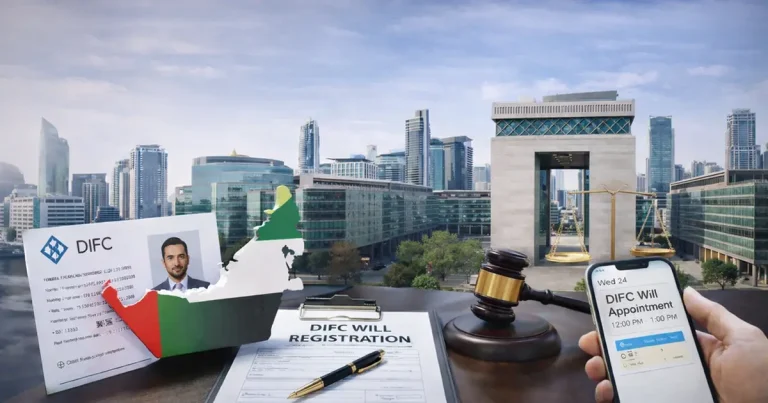
Documents Required for DIFC Will
The DIFC Wills and Probate Registry is a highly popular choice. It applies specifically to non-Muslim individuals who are over the legal age of majority.
The DIFC legal system is based on Common Law (similar to the UK system), which offers expats a familiar and highly robust legal framework. Importantly, the will must be written entirely in English and must follow the highly specific format of a DIFC Schedule 1 form.
For a step-by-step DIFC route (requirements, fees, appointment flow, and will types), see: https://insightadvisory.ae/insights/difc-will-registration-guide-costs-steps
To successfully register here, the specific documents required for DIFC will include:
- All Pre-Drafting Documents: Complete personal details, exhaustive asset inventory, and all executor/beneficiary information.
- The Drafted Will: Formatted in the specified English form, clearly stating it is a DIFC Will and outlining your wishes.
- Proof of Age: Proof you are over 21, satisfied by clear copies of passport and Emirates ID.
- Witness Documentation: At least two independent witnesses; have their passport/ID copies ready.
- Payment of Registration Fees: Currently AED 10,000 for a single will; up to AED 15,000 for mirror wills.
One of the major benefits of the DIFC registry is flexibility. The signing process can be done via physical presence at the registry, or via a virtual video call before a DIFC Registrar or Authorised Officer.
Documents Required for Dubai Courts Will
Dubai Courts offer a highly established, traditional route for will registration. This registry mandates very specific asset reporting. Furthermore, because Dubai Courts operate in Arabic, they require mandatory Arabic legal translation for any wills that are originally drafted in English or another language.
Both Muslims and non-Muslims can use Dubai Courts, though the legal frameworks applied to the documents will differ. The specific documents required for Dubai Courts will include:
- All Pre-Drafting Documents: Personal details, executor IDs, and beneficiary passports.
- Strict Asset Proofs: Emphasis on a full, proven asset list including title deeds, bank account statements, and stamped share certificates.
- The Drafted Will: Full executor and beneficiary details; signed before two independent witnesses.
- Arabic Legal Translation: Mandatory, and must be completed/stamped by a Ministry of Justice-approved legal translator in the UAE.
- Proof of UAE Assets (For Non-Residents): Allowed if you have physical or financial assets located within the UAE and can document them.
For a full expat-focused walkthrough of the Dubai Courts process (documents, fees, notary/attestation, and guardianship clauses), read: https://insightadvisory.ae/insights/dubai-courts-will-registration-expats-2026
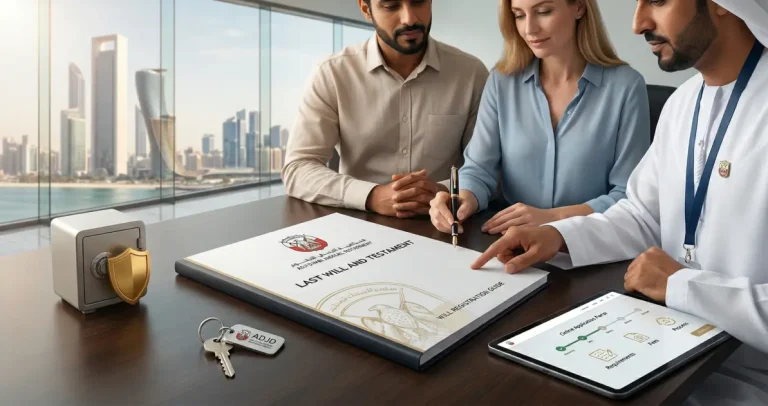
Documents Required for ADJD Will
The Abu Dhabi Judicial Department (ADJD) is an increasingly popular registry for expats and residents across the entire UAE—not just those living in Abu Dhabi. The ADJD serves both Muslim and non-Muslim testators.
What makes the ADJD unique is its highly digitized process. The entire initial procedure involves submitting an online application containing either an Arabic or a bilingual (English and Arabic) will.
To move forward with this route, the specific documents required for ADJD will include:
- All Pre-Drafting Documents: Passport copies, Emirates ID copies, and documentary proofs of all included assets.
- The Bilingual Will Document: If drafted in English, translated into Arabic by a sworn, certified translator, then uploaded via the ADJD online web portal.
- Completed Online Application Form: Digital form completion plus supporting PDFs for online verification.
- Payment of Fees: Typically AED 950 to AED 1,900 depending on complexity/type.
If you want the complete online ADJD process (including video call notarisation and fees), use: https://insightadvisory.ae/insights/adjd-will-registration-online-guide
The ADJD process is highly streamlined. Virtual options and video conferencing are heavily utilized and widely available for final submission and verification.
Witness and Notarisation Requirements UAE Will
Drafting your will and gathering your asset documents is only the first half of the journey. The final, critical step is execution. Execution is the formal legal process that transforms your drafted document into a legally binding, court-recognized instrument.
If you do not execute the document properly, a judge may declare the will invalid, rendering all your hard work useless. The testator must follow strict, specific rules to ensure validity across all UAE jurisdictions.
Witness Requirements UAE Will
Every jurisdiction in the UAE requires independent people to witness you signing your will. This proves that you signed the document willingly, without coercion, and while of sound mind.
To ensure your document is legally sound, you must carefully follow these witness requirements UAE will:
- Age Requirement: At least two witnesses must be present; both should be 21+.
- Independence: Witnesses must not be beneficiaries. If a beneficiary also witnesses, a court may void that gift. Ideally, witnesses should not be spouses of beneficiaries.
- Documentation: Provide witnesses’ full legal names, nationalities, and clear copies of passports and Emirates IDs.
- Presence: Witnesses must observe you sign at the same time—either physically or via recorded video call where permitted. DIFC explicitly allows virtual witnessing.
Notarisation Requirements UAE Will
Notarisation and registration are the final official stamps of approval from the UAE government. This process legally binds your wishes to the UAE court system.
To successfully finalize your estate, you must follow these notarisation requirements UAE will:
- Formal Signing: The testator signs in the presence of two witnesses; the executed document is submitted to the relevant registry.
- Timeline: Notarisation/registration occurs strictly post-drafting—only after documents are gathered, verified, and translated (if required).
- Physical vs. Virtual: Video verification and virtual notarisation are widely used for DIFC and ADJD.
- Online Submissions: For ADJD, submission, uploads, and payment are conducted completely online with identity verification by video call before the digital stamp is applied.
Because this final stamping process is strict, even small errors can trigger rejection. It is highly recommended to engage a legal expert to review your documents before booking your notarisation appointment.
Protect Your Assets Today
Organizing an estate can feel like a daunting task. However, leaving your family’s future to chance in a foreign legal jurisdiction is a risk no resident or expat should take.
While the paperwork and administrative steps may seem rigorous, utilizing this UAE will registration documents checklist ensures your assets are protected securely. By gathering the right personal details, asset proofs, and translations in advance, you avoid unnecessary delays, eliminate legal friction, and prevent rejected court applications.
Most importantly, completing this checklist provides you with peace of mind—knowing your children are protected, your assets are secured, and your final wishes will be respected exactly as you intended.
If you’re still weighing DIFC, Dubai Courts, and ADJD (including cost and convenience), use this comparison guide: https://insightadvisory.ae/insights/difc-vs-dubai-courts-will-guide
Next Steps: Secure Your Legacy with Insight Advisory
Do not wait until it is too late to protect everything you have worked so hard to build. Our dedicated corporate and legal services team is here to handle the heavy lifting for you.
We invite you to reach out to us today to ensure your documents are perfectly prepared. You can contact Insight Advisory directly at 050 518 3637 for a free, confidential document review. Alternatively, visit our contact page to book a comprehensive consultation. Let us officially draft, translate, and register your Will today so your family’s tomorrow is fully secure.
Disclaimer: This article is provided for general informational purposes only and does not constitute legal advice. Laws and regulations in the UAE are subject to change. For specific legal counsel regarding your situation, please consult with a qualified professional at Insight Advisory.
FAQ
What happens in the UAE if I die without a registered will?
Without a registered will, local laws may dictate asset distribution, which can result in frozen accounts, delayed property transfers, and complications around guardianship—especially for minor children.
Which documents should I gather before meeting a lawyer or registry?
Start with foundational documents: your passport and Emirates ID copies, full contact details, a detailed asset inventory with proofs (title deeds, bank details, share certificates), and complete executor/beneficiary/guardian identification documents.
Do I need Arabic translation for my UAE will?
It depends on jurisdiction. Dubai Courts require Arabic legal translation via a Ministry of Justice-approved translator for wills drafted in other languages, while DIFC wills are in English and ADJD commonly uses Arabic or bilingual documents.
Can witnesses be family members or beneficiaries?
Witnesses should be independent and must not be beneficiaries. If a beneficiary also acts as a witness, a court may void that beneficiary’s gift. It’s also advisable to avoid witnesses who are spouses of beneficiaries.
Is virtual notarisation available in the UAE?
Yes, virtual options are commonly used, especially with DIFC and ADJD processes, where video calls can be used for witnessing/identity verification depending on the registry’s rules.