
The Complete Guide to Dubai Courts Will Registration for Expats (2026)
Living in the UAE offers incredible opportunities—tax efficiency, world-class infrastructure, and a safe environment. Yet many expats avoid one uncomfortable topic until it’s too late: what happens to your assets and your children if you pass away without a locally recognized will.
If you die without a registered legal document, UAE Sharia law automatically governs the distribution of your assets—and it can also influence guardianship outcomes for minor children.
This can mean frozen joint bank accounts, delays, and distributions that do not match your personal wishes or your home country’s inheritance expectations. The solution is straightforward: take the correct legal steps now, while you have full control.
This guide explains Dubai Courts will registration for 2026: the “why,” the documents, the exact process, and realistic costs—so you can confidently apply your preferred home country laws and protect your family.
Key Takeaways
- Without a registered will, Sharia principles may be applied to UAE-based assets—even for non-Muslim expats.
- Dubai Courts will registration is a practical legal “opt-out,” enabling you to apply home country laws for asset distribution.
- A Dubai Courts will typically must be bilingual (English + Arabic) and the translation should be completed by a legal translator.
- For families, a clear guardianship clause helps you avoid default guardianship rules and reduce uncertainty.
- Expect an overall budget commonly in the range of AED 5,000 to AED 10,000 depending on drafting complexity, translation, and government fees.
Why Expats Must Secure a Will in Dubai
To understand why this matters, start with the default outcome. When a non-Muslim expat dies in Dubai without a locally recognized will, the UAE personal status framework can apply—meaning Sharia principles are applied to UAE-based assets.
This default rule can cover:
- Real estate: villas, apartments, land
- Bank accounts: sole and joint accounts (which can be frozen upon death)
- Business shares: mainland or free zone company stakes
- Digital assets: crypto, online accounts, digital wallets
Under formula-based distributions, your spouse may not automatically inherit your full estate; other relatives may receive defined shares. The result is often delay, uncertainty, and avoidable court involvement.
The Legal Opt-Out: Choosing Your Own Law
You’re not required to accept the default path. A properly registered will can allow you to apply the laws of your home country instead—so your distribution aligns with the system you’re familiar with.
When you decide to register a will in Dubai as an expat, Dubai created formal routes for non-Muslims—commonly through Dubai Courts or DIFC Courts—so your wishes can be enforceable locally and you can protect your assets from default local laws.
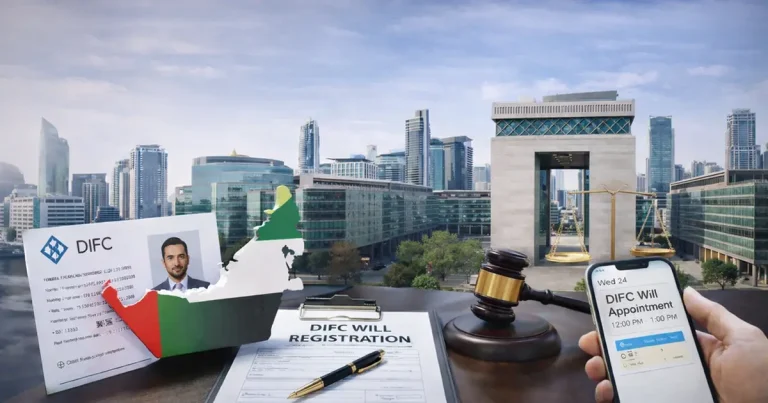
If you want a structured comparison of DIFC will types (property vs financial assets vs business owners) and practical appointment mechanics, use: DIFC will registration guide (costs & steps).
What Must Be Included in Your Document?
A standard will from your home country is often not enough by itself. For local acceptance, your will must be clear, structured, and specific—especially around assets located in the UAE.
To minimize delays, your will should explicitly include:
- An appointed executor: the person responsible for administering the estate, settling liabilities, and distributing assets.
- Listed beneficiaries: complete names and clear allocations (who gets what).
- Complete asset coverage: list movable vs immovable assets, tangible vs intangible assets—because detailing every single asset is legally required.
If your estate includes Dubai property, UAE bank accounts, or business shares and you want a reference point on common will categories, review: DIFC will categories overview.
Protecting Your Children (Guardianship)
For parents, the most important section is often guardianship. If both parents pass away, guardianship decisions may be left to default rules and court determinations.
A strong guardianship clause helps you name who should care for your minor children—often by appointing both temporary and permanent guardians. This is designed to avoid the default guardianship rules and align outcomes with your intentions, consistent with the ability to apply your preferred home country laws.
If you’d like to see how guardianship-focused options are commonly structured in DIFC registrations (single vs mirror and guardianship wills), review: Guardianship-focused will options (DIFC guide).
Gathering Your Paperwork (Preparation Phase)
Before you book anything, prepare your documents. UAE processes are efficient—but strict. Missing paperwork can mean a rescheduled appointment and unnecessary delay.
Practical tip: Put everything into a single folder in the order you expect to present it (IDs → asset proof → draft will → translator documents → witness IDs).
The Ultimate Document Checklist
To be ready for Dubai Courts will registration, gather the following documents required for Dubai Courts will processing:
- Personal identification: original passport, UAE residence visa, original Emirates ID.
- Proof of asset ownership: title deeds, stamped bank statements, vehicle registration, share certificates.
- Executor and beneficiary details: clear color passport copies; relationship proof (marriage certificate, birth certificates).
- Final will draft: typed, error-free, including the guardianship clause if minors are involved, and formatted according to local standards.
For a practical reference on common will types (single vs mirror) and what each typically covers, see: Single vs mirror wills (DIFC guide).
The Language Rules You Must Follow
One of the most common mistakes is arriving with English-only paperwork. Dubai Courts generally require Arabic for court-facing documentation—so your will should be bilingual. By contrast, DIFC processes often accept English-only documents, but for Dubai Courts you typically need an official bilingual document.
You also cannot rely on informal translation. The translation must be done by a legal translator licensed by the UAE Ministry of Justice.
If language and document preferences are central to your decision, this overview may help: DIFC registration overview.
Why You Need Legal Help and Witnesses
Drafting a will incorrectly can create ambiguity that invites disputes later. Using a qualified practitioner helps ensure your will is enforceable and aligned with local requirements.
You’ll also typically need two independent witnesses for signing. Common witness criteria include:
- Over 21 years old
- Valid identification (passport and Emirates ID)
- Not beneficiaries—because a beneficiary cannot be your witness
A Quick Note on Embassy Wills
Some expats consider embassy/consulate wills. Depending on your nationality, it may be an option—but it often creates extra steps (attestation, translation, validation) before local enforcement is practical. Direct registration can offer direct, immediate UAE legal enforcement.
For a side-by-side look at local UAE will-registration routes (including DIFC appointment requirements), use: Local UAE will-registration routes (guide).
The Step-by-Step Execution
Once your paperwork is ready, the Dubai Courts pathway is structured and notary-led. Below is a clear execution roadmap.
Step 1: Draft the Document
Avoid generic templates. Use a UAE-licensed lawyer to draft and structure executor roles, beneficiary allocations, asset schedules, and guardianship language. Drafting costs often fall around AED 3,000 to AED 6,000, depending on complexity.
If you’re comparing drafting and registration costs (Dubai Courts vs DIFC), see: Cost comparison guide.
Step 2: Translate to Arabic
Dubai Courts generally require Arabic documentation. Ensure translation is handled by a licensed legal translator so terms align properly in both languages.
Step 3: Gather the Final Documents
Organize originals and copies, ensuring IDs are valid and you have proof of ownership (including original copies of property deeds and bank statements where applicable).
Step 4: Book an Official Appointment
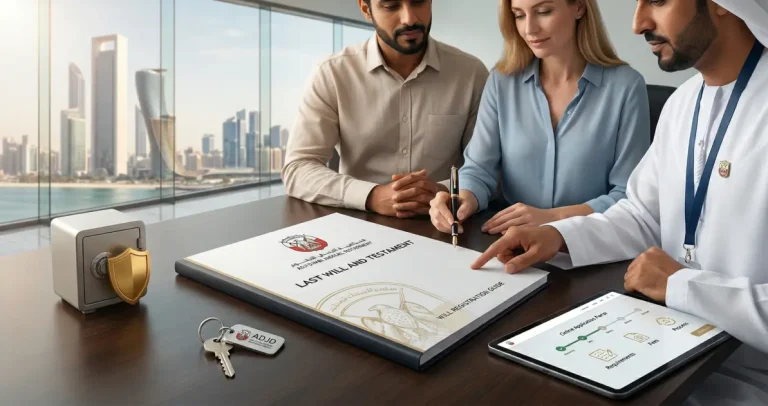
You’ll need an appointment with the Notary Public. Dubai continues to expand digital service capability, with systems similar to ADJD-style portals that can support scheduling and preparation, and it may be possible to secure your time slot digitally.
For an additional reference on booking and preparing for DIFC will appointments, visit: DIFC appointment preparation guide.
Step 5: Attend the Attestation
Attend with your two witnesses and identification. The notary will confirm understanding and voluntary signing. This is the Dubai Courts will attestation step that finalizes the legality of the document and helps prevent challenges that claim it is fake later.
Step 6: Notarization and Registration
After signing, the notary applies official stamps and the will is scanned and entered into the relevant register—effectively completing Dubai notary will registration in the government register for non-Muslims.
Timelines and Jurisdiction
With proactive preparation, many expats complete drafting → translation → appointment → registration within 1 to 4 weeks. Timing usually depends on drafting speed and how fast you can book an appointment slot with the relevant officials.
If you’re also considering DIFC convenience pathways, note that DIFC has emphasized virtual options in recent updates; however, many expats still prefer Dubai Courts because documents registered directly at the city courts enforce directly in the city, potentially saving time during the final execution. For deeper DIFC timelines and steps, see: DIFC timelines & steps.
Understanding the Financial Investment
A will is a financial investment in certainty. The alternative—frozen accounts, disputes, and prolonged court steps—can cost far more in money and stress.
Dubai Courts will fees are often viewed as cost-effective compared to DIFC routes where registration alone can easily exceed AED 10,000. For a DIFC fee breakdown, refer to: DIFC fee breakdown (single vs mirror).
Typical cost components to budget:
- Government registration & notary fees: often quoted around AED 950 (single) and up to AED 1,900 (mirror), with references to official ADJD parallels.
- Legal drafting fees: commonly AED 3,000 to AED 6,000+ depending on complexity.
- Translation & administration: often AED 500 to AED 1,500 depending on length and translator pricing.
Your total estimate: Many expats frame an overall budget around AED 5,000 to AED 10,000, varying with asset count and family structure.
A note on future changes: If you need amendments later, some updates can be comparatively modest; for example, simple government updates may cost around AED 550.
Conclusion
You’ve worked hard to build a life in the UAE. Don’t leave your family exposed to uncertainty. A properly executed Dubai Courts will registration gives you control over asset distribution, reduces the risk of frozen accounts, and helps protect your children through explicit guardianship instructions.
If you’re ready to proceed, use official channels and professional support to book an appointment to draft and register your will immediately. If you’re still deciding whether Dubai Courts or DIFC is best for your situation, read: Dubai Courts vs DIFC (guide).
Next Steps
Are you ready to protect your legacy in the UAE? Reach out to the experts at Insight Advisory to guide you through a seamless process.
Contact us now for a free consultation.
FAQ
1) What happens if an expat dies in Dubai without a registered will?
UAE processes may apply to the estate, and Sharia principles can govern UAE-based assets. This can cause delays, account freezes, and outcomes that differ from your intentions.
2) Can I choose my home country law for my Dubai-based assets?
Yes—by registering an appropriate will, non-Muslim expats may be able to apply the laws of their home country rather than default rules.
3) Do Dubai Courts require an Arabic version of the will?
In many cases, yes. Dubai Courts generally require Arabic for legal filings, so a bilingual will is common. DIFC can be more flexible, but Dubai Courts typically expect an official bilingual document.
4) Who is allowed to translate my will into Arabic?
Use an officially licensed professional; the translation must be done by a legal translator authorized under UAE requirements.
5) Can a beneficiary act as a witness when I sign?
Generally no. Witnesses should be independent, and guidance notes that a beneficiary cannot be your witness.
6) How much should I budget for Dubai will registration end-to-end?
A common planning range is AED 5,000 to AED 10,000 including drafting, translation, and government fees (depending on complexity).
Disclaimer: This article is provided for general informational purposes only and does not constitute legal advice. Laws and regulations in the UAE are subject to change. For specific legal counsel regarding your situation, please consult with a qualified professional.